About Lasqueti

Lasqueti Island lies in the Georgia Strait, north of French Creek (on Vancouver Island), and southwest of Texada Island. It is approximately 8 km wide and 22 km long, with an area of 73.56 km2. About 425 permanent residents call Lasqueti home (2011 census). It is accessible by foot passenger ferry service only, or by private boat or plane.
The roads are unpaved and the island has no public transportation. There are no public camp grounds. Lasqueti is not serviced by B.C. Hydro. Residents live either without electricity or with alternative sources of power like solar or micro-hydro. There is very little industry and no bustling economy.
Currently, the best maps of Lasqueti can be found at the Island's Trust.
Life on Lasqueti
| "Lasqueti -- halfway between Dogpatch and Shangri-la" |
| as the island cookbook describes it. |
Residents are accused of trying to put the clock back, living a self-sufficient lifestyle reminiscent of an earlier century. Lasqueti ís the place where the conversation is more likely about solar panels or composting toilets than about microwaves or toasters -- foreign objects for most of the 400 residents. Nobody can work a five-day week away from home because it takes three days work just to survive -- to cut firewood, to maintain power, water, and waste systems, to work in your garden to produce your food. An island of individuals, with poets, artists, physicists, fishermen, loggers, tree planters, designers, professional musicians, published authors, some small scale manufacturers, some commercial agriculture, mariculture as well as professional consultants in education, engineering, forestry and alternate energy make up a population that Statistics Canada says is the most highly educated community in British Columbia. Lasqueti lies about 50 miles northwest of Vancouver in the Strait of Georgia. The island is about 12 miles long and three miles wide, the same size and shape as Manhattan.
So you want to come visit, eh?
Many folks contact us through the website wondering how they can visit Lasqueti and experience our unique lifestyle (I've posted a few sample messages below for your amusement :-)
- If you are looking for a vacation / relaxed visit, please see the accommodation listings: http://lasqueti.ca/visitors/view/accommodation
You may have to try a few places, as most are small, family-run B&Bs, and not all are open year-round, but persevere - someone will help you arrange accommodation, travel, and other plans.
- If you are more interested in a "life experience", there is no better introduction than through the WWOOF program: https://wwoof.ca/
You will live and work with your host, experience their lifestyle first-hand, and get connections to the rest of the community. There are several WWOOF hosts on Lasqueti, and once you are here, you may find others willing to do work-trade accommodations. - If you are looking to buy real-estate, try: Wesley Yule
Wes can help you understand the real-estate market here.
- If you are looking to camp - sorry, there are no campgrounds, and no camping allowed in any parks nor on crown land. If you are looking to squat, probably best to look elsewhere - this is a pretty tight-knit place.
- You may also register for an account and post a classified ad if you are looking for longer-term rentals, land co-ops, etc.
However you decide to come, and whatever you are hoping to find here, please keep this in mind: Lasqueti is not some utopian paradise, it is not an "intentional community", and it is probably not whatever you think it is - it is just a relatively remote island, populated by a small, tight-knit community of quirky, independent-minded people, with its own unique culture and identity. Come with an open mind, a willingness to discover something a little different, and without rigid expectations. Resist the urge to project upon us your vision of what this place "should" be. It is what it is, and we like it this way, warts and all. If you can get with that, you too may find a place here.
A few important things to note:
- Pack-it-in / Pack-it-out: no waste services here, please come prepared to take your garbage back with you.
- Transportation: there are no public transport or vehicle rentals, and no way to bring a car. Bring a bike, arrange a taxi, wear sturdy shoes, and/or use your thumb.
- In Summer: Farmer's Market every Saturday; Arts Picnic (for kids) on Thursdays; Festivals throughout the summer. Please support the local economy while you are here.
Can I live on Lasqueti?
We get 3 or 4 requests a month asking how one goes about visiting / renting / buying / working on Lasqueti, or just about what life is like here.
Here are few real messages we have received, with apologies for my irreverent answers:
Is there free land in Lasqueti?
No.
Living on the island seems like the perfect place for me to go, I just don't know what I'll do when I get there, or first of all, how I will get there. Any tips or help?
WWOOF...
Is everyone welcome to Lasqueti ?
Only nice people.
I am just wondering if you have camping available?
No
How much do you have to pay for land on the island
How much do I have to pay or how much do you have to pay?
I was wondering if anyone is allowed to move to Lasqueti Island?
We were wondering if there is some way to stop 'em.
i just need more info on migrating to your community. can you show up and just find crown land to live off of?
No.
i was wanting to see if i am able to survive off the grid with my two small kids
i have most camping gear..please let me know.
I'd like to see that too!
I would like too buy some land on your island ,anything for sale?
Ask Lisa...
Are there any Building Codes on the Island?
Yes, but no Building Inspectors 
I must ask: Life there on Lasqueti seems like a rural paradise - I was wondering; how does one come to live in such a community or are all who live there descended from the original settlers?
It's not (paradise, that is); by moving (generally to Lasqueti, that is); No.
I heard about this place on the radio. Do you have an area for
vacationers? What is the weather like? What is there to do?
No. It rains constantly. Umbrella repair.
I have recently learned of your paradise and I would very much like to become a member.
It's not paradise! It's not a club
I am wondering if there is some matter I can apprentice to learn to fully survive on your island. I may have only a few skills, but I wish to contribute as much as I can.
It's all we'd ask of anyone :-) Try Jessie...
I'm wondering if a resident on the island would consider writing to me
and helping me figure out if moving there is a feasible idea? I'm looking
for information on living costs and the realities of living off-grid as a
single woman with little experience but a willingness to learn. Thanks for
your help.
You've come to the right place.
We've never been to the island and wondered if there is a pub at or near
the ferry dock.
Yes!
I would like to know how i would become a member of the lasqueti
community.we are a young couple trying to get away from the everyday
"norm".
Are you saying we're not normal?
I'm travelling around Canada with my friend Aurora, we think that the way you are living is very interesting, so we would like to meet you and stay a few days helping you or wathever. If it's possible please contact me, it would be so nice! thankyou and have a nice day!
We love you already - please come and WWOOF...
Hi. Saw the TV program and would love to live off the grid.
You saw it on TV, so it must be true!
I just saw a tv special on your island. I have to say it was one of the most inspirational things I have seen in a long time. The people that live there off the power and resources of the island amaze me. I think it is wonderful that you have found such a beautiful spot to enjoy the true wonders of the world in their natural state. I am not one that could cope with such a lifestyle, but I admire those that can. I would love to be able to visit the island, do you offer accommodations for people that would like to experience the wonder of your world? I would love to be able to show my children that there is more to life than the conveniences of modern life. It scares me that they could possibly grow up not appreciating the enjoyment of life without tv, computers and cell phones.
Please come - your kids need us. Visitors...
I came across your web site by accident when I saw your group profile
on http://kiva.org. I was interested in information about visiting Lasqueti
Island, perhaps as an initial visit to moving and living there.
Please come - Kiva rocks.
How to Shyte on Lasqueti
This is an updated, 2010, electronic copy of Doug Hamilton's book:
Shyte, Piss, and Dishwater
So you finally decided to make the big move to the country. Ah, the happy rural lifestyle--clean air, sparkling streams, friendly neighbors, a bursting vegetable garden, and goodbye forever to that stressful commute. But sometimes things are not as simple as they seem. While not exactly the center of polite conversation or learned discourse there lingers in the background of country living the nagging question of human waste. Many rural areas, particularly in the beautiful Gulf Islands, have no sewer pipe outlets, holding tanks, or processing areas. In the good old days before the current population explosion, a hole in the ground was grand, or even better, one could go for a soulful dump in the deep blue sea. Greywater was pitched out the window without a second thought. Incredibly, some cities like Victoria still show their respect for our environment by dumping human waste and greywater directly into the ocean without treatment.
The problem of shyte disposal is not academic question to be disputed in some ivory tower. Misplaced caca has caused more death and human suffering in the world than any other single factor throughout world history. Even a microscopic piece can be deadly-- jam packed with dangerous viruses, bacteria and parasites. Think hepatitis B, typhoid, diptheria, cholera, diarrhea, salmonella, hookworm, roundworm and many others, discovered and undiscovered. Many of these monsters have been quelled here, but thousands still die every day from their ravages in the third world. Be aware, one of the most deadly poisons known to humankind is produced by each and every one of us every day. Simply put, what has recently passed from a person’s (or animal) asshole must never find its way back into someone else’s mouth and digestive system.
| Attachment | Size |
|---|---|
| How to Shyte on Lasqueti (PDF) | 84.29 KB |
Shyte Regulations
In 2005, the rules and regulation concerning wastewater in British Columbia were drastically changed. As part of the Gordon’s Campbell’s obsession with privatization, the Health authorities lost control over such matters as septic fields and greywater. As a result, they have no advice, nor suggestions about these systems. Instead, overseeing greywater and septic planning has been turned over to the private sector industry, in this case the ASTTBC or Applied Science Technologists and Technicians of British Columbia.
Their website for wastewater information is: http://wastewater.asttbc.org/c/index.php.
The rules are draconian, and intensely bureaucratic—yet another example of the narrow minded view that one-size-fits-all--in a province of mind boggling diversity in climate, terrain, ecosystems and population density. More and more these days one cannot do the simplest things around the home without falling afoul of the law and becoming a criminal. Here is a sample from the site.
What is an Authorized Person?
The Sewerage System Regulation (SSR) provides for two types of ‘Authorized Person’: a Registered Onsite Wastewater Practitioner and a Professional. No others may plan, install or maintain systems in British Columbia. Doing so is illegal and considered an offense under the Regulation.
Registered Onsite Wastewater Practitioner
Depending on training and qualifications, a Registered Onsite Wastewater Practitioner (ROWP) plans, installs, maintains and/or inspects onsite systems. They are registered with the Applied Science Technologists & Technicians of British Columbia (ASTTBC). To be registered, individuals must complete the required education, a Professional Practice & Ethics exam, provide references, and demonstrate experience by successfully completing a Practice Assessment.
As far as I can tell there have been few prosecutions for breaching these regulations. It is hard to imagine a simple greywater system would excite much interest or criticism. But, if the health department receives a complaint and discovers a gross sewage violation, especially near a watershed used for collecting drinking water, the punishment could be brutal—say a fine of $10,000-$100,000.
Of course, this author would never dream of inciting anyone to break the law. All suggestions in this little essay are purely theoretical and hypothetical.
Septic Fields
The ASTTBC swears by the septic field. This time honored method involves digging out an area for large holding tank, and a 50’ by 50’ absorption field. Drainage pipes are buried in the field to disperse the waste. A mantle of specially approved gravel is laid to a depth of 10” along the pipes followed by another 3’ of imported sandy soil to improve absorption. In some places this method works very well, but it does have its problems. What happens when the homeowner’s yard is a rock bluff, which cannot be dug? Or, suppose the area is entirely under water during the winter months? These are not unusual circumstances in rural areas. In these cases, putting in septic field is a complete waste of time and money.
Then there is the problem of disposal. A septic tank has to be cleaned out every three to five years. These systems work on the basis of creeping failure. As solids build up in the tank and dispersal pipes, there is less space for the sludge and scum to settle out before seeping into the leaching field. Unattended, your system backs up, bringing a pond or stinking rotted sewage to the surface. Beware, when this happens your field has failed, and the whole thing will probably have to be replaced. In many rural areas it is simply not practical to bring in a truck to pump out your tank. Tankers must be barged over to isolated islands at great expense, and some areas are simply inaccessible for these large unwieldy vehicles. In these cases, it is not uncommon for the landowner to take matters into his own hands and simply pump out the filthy contents of his tank on some remote area of his property. So why go to the enormous expense of installing a septic system in the first place?
There are other problems as well. A septic field is not a closed system and there cannot help but be some contamination of ground water. When a number of these fields are located in a crowded subdivision, wells and drinking water will be dangerously contaminated-- as happened on Mayne Island a few years ago. Plus these systems are vulnerable to physical damage. Grease, chemicals, diapers, coffee grounds, paper, plastics tampons, indeed, anything other than human waste, will clog and eventually destroy your septic field. Care must be taken not to compact the soil and pipes by forgetting their location and driving over them. And be careful not to get too intimate with your tank during inspection and cleanout. Every year there are always a few poor souls who pass out and expire, asphyxiated by the delicate fumes of their own waste.
Yes, I know. The great appeal of septic fields is that they encourage the comforting yet antiquated flush toilet. A quick jerk of the chain and all those embarrassing sights and smells vanish magically into the void forever. Such squeamishness may be regarded as criminal in the near future. So what are the alternatives?
Shyte Alternatives
If Septic Tanks have their failings, what are the alternatives?
No Toilet
When the urge strikes in the big outdoors and no “rest room” is available, look for a well-drained site with diggable soil, 150’ from the nearest lake or stream. The most powerful soil enzymes are in the top 8”, so dig a hole to that depth and cover. Use as little toilet paper as possible. Even better, crap into a plastic bag and pack it out. Of course, all toiletries like diapers, tampons, sanitary napkins and condoms should also be taken home and disposed of properly.
Outhouse
This time honored method works fine over the short term when the density of people is low. Outhouses though, leach their contents into watersheds over time as the waste is not sealed in a watertight container. In some parts of the undeveloped world it is not uncommon to see a drinking well and outhouse within a few feet of each other. This is obviously a recipe for disaster. But, an outhouse is better than nothing, so if you must use this method look for a well drained site at least 150’ from the nearest watershed.
Composting Toilets
In isolated inaccessible rural areas the most sensible and safest method for disposing of human wastes is composting.
Composting Toilet
In isolated inaccessible rural areas the most sensible and safest method for disposing of human wastes is composting. If you are short on time and long on money, a reliable commercial composting toilet can be purchased or constructed. Look online for factory made units and plans. The rudiments of rot allow for two methods of composting. Anaerobic (without oxygen) compost occurs when turds are all piled up on each other with no added organic material. This is what happens in the traditional outhouse. Here the process moves slowly and often incompletely. Foul smelling compounds like hydrogen sulfide are released and little heat is generated to kill pathogens. Aerobic composting (with oxygen) works quite differently. Handfuls of organic material sawdust, grass clippings, peat, straw or leaves are added each day after use. Periodically the contents are mixed by hand or motor for several weeks. The process takes place quite quickly and few smells and a lot of heat are generated. To add piss or not to add piss is an interesting question. Urine mixed with caca will present special problems, but it can be impossible to completely separate it. Piss is very high in nitrogen and can smother the composting process, so much additional organic matter will have to be added for successful composting if large quantities are being added to the mix. As urine is close to sterile when fresh, some simply collect it and store separately. It makes an excellent fast acting garden fertilizer when diluted 3 to 1 with water.
A Homemade Composting Toilet
A homemade shyte composter can be easily assembled from simple materials. The container must be waterproof and leak free. It should also be kid and animal proof. A 4 to 45 gallon steel drum works nicely. (see diagram my book pg. 12) Or consider a 4’X4’X4’ wooden box lined with plastic with enough overlap to keep out the rain. This is also a good size to maximize heat retention. Top with a piece of plywood and add sawdust after each use. (see diagram my book pg. 14) It should take two people about 8 years to fill. Temperature is critical for successful composting. Organic materials do not begin to break down until the temperature reaches 18C, ands things slow down during the winter months. Paint the box black and leave it in the sun--- or even add a heating coil if you want it to process quickly. If the pile is too wet or too dry composting will be delayed. Below 40% moisture stops the process all-together, while above 70% causes the anaerobic process to take over. Somewhere in between leaves the pile damp but not sopping.
How to Use your Composting Toilet
Remember you can never add too much sawdust, straw or leaves to your toilet and to your composter. Microorganisms need carbon for energy and growth. They also utilize a small amount of nitrogen. Thirty parts carbon to one part nitrogen is optimum for composting. Less than 20 to one and the pile starts to stink. The Ph will be slightly acidic so add a dash of lime or ashes now and again. For speedy action the pile should be thoroughly mixed every month for the first 6 months and then every 3 months. This feeds oxygen, nitrogen and carbon to the bacteria that are doing all the work. Keep your shyte stirring tools separate from regular gardening implements.
How long before your compost is safe to handle? Much depends on temperature. If you keep it above 18C you should have beautiful compost in 6 to 8 months. If your composter is outside and unheated, the time will be a good deal longer. Always err on the side of caution! Anyone with a serious infection like Hepatitis B, Giardia, or Cryptosporidium should be prepared to compost for several years. Never use your compost directly on food that will be eaten directly from the garden. Use instead on fruit trees and ornamentals.
But here’s a thought. When your composter fills up, simply abandon it and build another. The main thing is to keep fecal matter dry and isolated until it is thoroughly composted and safe. If you don’t feel comfortable or have the time to put extra energy into such things as turning the pile, and obsessing on temperature and moisture you really do not have to. Just mix your movement with sawdust in a watertight container and forget it. It will take longer to work out, but 15 years down the road when the box rots or rusts away it will be no danger to anyone. And using this homemade fertilizer in the orchard is not really necessary either, although it makes one feel a part of the great cycle of life and closer to the planet.
Greywater
Everyone living in a rural area should have a working greywater system. Most do not, and many others do not even know what it is. For the record, greywater is all household waste water except sewage/toilet water (better known as black water). It includes water from laundry, dishes and the bath. Because of dangerous fecal contamination, it would not include diaper rinse, or water used in cleaning animal stables, or bath water from someone with a communicable disease. But the line is a fine one. Greywater will usually contain some level of black materials like dead skin, food particles hair saliva, grease, detergents, crap residue , bacteria and chemicals. The question is how much is too much?
Because of the possible dangers, most municipalities do not distinguish between black and grey water. All household wastewater is considered black and must be disposed of in a sewer pipe, septic field or collecting depot. In areas with septic fields only, this puts a tremendous strain on the system. Our wastewater authorities are encouraging the use of septic fields to dispose of greywater, but owners should realize that the life of their field can be greatly prolonged by reducing water input. As an alternative, a simple system can be set up for home use cheaply and easily. Here area few suggestions.
-
Greywater systems do not work well in crowded areas. If you have only a quarter acre and are surrounded by other homes some other alternative may have to be found.
-
Greywater is best absorbed and neutralized by living plants. Soil organisms break down organic materials into water soluble plant nutrients. Plant roots take up these nutrients and much of the water as well. The pure water left over seeps down to replenish the aquifer. As a sensible precaution do not use greywater directly on anything you will eat later like radishes, carrots, potatoes and lettuce. Instead place your outflow in orchards, pasture, and on ornamentals. Lawn watering is acceptable but beware of possible contamination for animals and children. If you prefer a self regulating system, site your outflow on a well drained part of your property well away from streams and neighbors. Dig out a 6’X6” hole and fill with sand to filter and increase absorption.
-
Filter and strain all greywater to remove the larger particles of food, grease, etc.—compost or feed this to your chickens. Set up a steel drum or wooden box with different layers of materials for additional filtering (see diagram my book pg. 20). Sawdust or woodchips is best for your first layer. Direct the outflow into your leach field—an upside down flower pot with the pipe stuck in the top makes for splash free dispersal. Dilute with 50% freshwater for best results although this is not always necessary. On well drained sandy soil figure about a half gallon of greywater per week for every square foot of soil—less for hardpan. Keep an eye on things to see how the plants respond.
-
Your ideal system might include a pit lined with plastic and filled with topsoil. Greywater would feed the trees and ornamentals in the pit without leakage into surrounding soil. If you want to get fancy bury some perforated plastic pipe to disperse the filtered water like a septic field. (see my diagrams pg 22 &23)
-
Keep greywater in pipes or underground as much as possible. Do not spray on plants or hard surfaces as this defuses the water into microscopic droplets, which could spread contaminants. Do not store for more that a day or two or allow to puddle. A thick mulch of hay, wood chips or even cardboard speeds decomposition and provides protection for youngsters and pets.
- Avoid bleach, fabric softeners, boron, phosphates, ammonia, chemical cleaners, and hot water, as these will damage plants.
I dyde shyte on Lasqueti
So what are we to make of this story of caca, piss and dishwater? It is unfortunate that the authorities are clinging to old 19th century technologies in dealing with human waste problems today. Septic fields and sewer pipes certainly had their place at one time, but the many shortcomings of these systems dictate the need for a whole new approach. And consider the wastage of all that good humanure for fertilizer in a world of rapidly increasing hunger. Increasing populations and the shortage of fresh water will eventually force major changes in how this problem is handled. The writing is on the wall. It is a great pity that government and the private sector are not aggressively encouraging alternative technologies, especially in Canada’s Gulf Islands, where public treatment and cleanout facilities are sparse or nonexistent, except on the larger ones. After all, people have to dump their personal wastes and wash water somewhere.
As Aesop candidly observed way back in ancient Greece
“I dyde shyte tre grete toordes.”
(Fables of Aesop, Caxton Translation, Vol. 15, 1484).
Hopefully this little essay will spark some discussion about these much neglected, yet critically important subjects.
Suggested Reading
The Humanure Handbook: A Guide to Composting Human Manure by Joseph C. Jenkins, 2005: Chelsea Green Publishing, PO Box 607, Grove City, PA.16127.
Water Purification Systems
Like many 'services' on Lasqueti, domestic water supply is a do-it-yourself affair for most of us. Typically shunning drilled wells, many households rely on rain-water collection in cisterns, shallow wells, or open ponds to supply water to their homes. Surface and stored water sources can harbour nasty bacteria, viruses, and cysts that may cause waterborne illness, ranging from the unpleasant to the lethal.
I asked Lasquetians how they treated their domestic water… this is what I found.
(** Caveat emptor: this article makes no recommendation and should not be interpreted as advice.)
Multi-stage Filtration
There are a wide range of water purification technologies in use on Lasqueti, but the constraints of this lifestyle appear to favour water filtration systems. A variety of different filtration systems in use on Lasqueti are documented below, but one strategy common to many systems is “multi-stage filtration”.
A typical multi-stage filtration system might have these components:
- intake screen;
- sediment screen or ‘irrigation filter’;
- sediment filter;
- drinking water filter
Stage 1: Intake Screen
- A rough screen on the water intake to filter out larger solids - typically filters out solids greater than 1 mm
- Should be cleaned periodically by reverse flushing, or just hauling it out and brushing off accumulated crud.
- Simple, cheap, and effective to keep debris from entering your system in the first place.
Stag 2: Sediment Screen / Irrigation Filter
- Typically a cylinder or disk with a fine mesh that uses water pressure to filter out solids larger than 150 - 250 microns.
- Screens out sand, sediment, algae, and other small particles without reducing the pressure.
- These screens are very easy to clean and cheap to replace. A cheap, effective way to keep drip irrigation and watering systems from clogging up, and to extend the lifespan of your down-stream filters.
- Water at this stage is suitable for gardening and flushing toilets (as if you had such a thing :-).
Stage 3: Sediment Filter
- Typically a 5 - 30 micron cartridge filter removes all but microscopic particles from water. Some water pressure is required, but not much.
- These filters are readily available and the filter cartridges are generally quite cheap to replace, thus making them an effective way to extend the lifespan of your downstream filters.
- This step als significantly reduces the 'load' of nasties, which often 'hitch a ride' on the larger particles filtered out at this stage.
- The water exiting the filter is clear and clean (but not yet suitable for drinking or washing fresh food). Water at this stage is well-suited to doing laundry and other cleaning chores.
- Although the CDC would definitely recommend against it, this water is often plumbed directly to showers and sinks.
Stage 4: Drinking Water Filtration Systems
This is where the bulk of my research was focussed. Below I document the pro’s and con’s for 4 systems in common use on Lasqueti.
- WaterSprite: http://watersprite.ca/
Distributed right here on Lasqueti by our very own, WaterSprite offers 2 distinct solutions, both of which use a Doulton Ceramic Filter. These filters can be cleaned and have a long lifespan. WaterSprite is local and offers free shipping in Canada. All the feedback I received from WaterSprite users was positive, and you are supporting a local business.- WaterSprite Gravity System - a countertop filtration and dispensing vessel
Pros: no water pressure required; water can be sterilized (i.e. boiled) before filtering
Cons: not a ‘running water’ source - WaterSprite Counter-top / Below Counter Systems - a ceramic cartridge filter and faucet
Pros: flexible, multi-stage purification with up to 4 different filtration media; sink-mount faucet
Cons: requires water pressure; ceramic filter needs to be cleaned ~ once/month or more
- WaterSprite Gravity System - a countertop filtration and dispensing vessel
- Activated Carbon Block
e.g. Multipure: http://www.multipure.com/The best of these filter to 0.5 microns, which is sufficient to filter out small cysts (like cryptosporidium), but this not true for all carbon block filters. Carbon filters tend inhibit growth of bacterial inside the filter medium, and with a pre-filter, these filters can last up to a year without maintenance.
- Pros: works with moderate water pressure; removes common contaminants (organic chemicals, heavy metals, etc.); anti-bacterial; low-maintenance
- Cons: varying quality and availability — look carefully for NSF/ANSI certification, along with cost and availability of replacement filter cartridges first.
- Dual-cartridge carbon / ceramic filter
e.g., RainFresh: http://www.rainfresh.ca/This was the system I received the most feedback about, all of it positive. This system uses a 3-stage filter - activated carbon block to remove sediment & odour; 0.3 micron ceramic to trap the nasties; with an activated carbon core, presumably to retard growth of bacteria in the ceramic filter media and ‘sweeten’ the water.
- Pros: Canadian company; locally available at several outlets in P’ville and Nanaimo; relatively inexpensive filter cartridges
- Cons: requires significant water pressure; ceramic filter needs to be cleaned ~ once/month or more
- Reverse Osmosis
https://en.wikipedia.org/wiki/Reverse_osmosisThese systems are also typically multi-stage, with 2 or more pre-filters, a reverse osmosis membrane, and typically a post carbon block filter, presumably to ‘sweeten’ the water. These systems may be impractical for many because they require substantial pressure (> 40 psi), and only utilize 25% of water (i.e., they produce 3 litres of ’waste water’ for every 1 litre of purified water, although that waste water can be re-captured and used for watering, etc.).
- Pros: removes virtually all contaminants, resulting in nearly pure H2O; deionized so can be used in batteries;
- Cons: water is de-mineralized; higher maintenance and costs; requires substantial water pressure; 25% water-use efficiency;
Finally, I received a recommendation for an online water purification business that sells variations on many of the above and more. For posterity: https://www.watercheck.biz/products
** Caveat emptor:
This article in no way should be seen to be recommending a specific system or advising on adequate sanitation for drinking water — it is intended only to document the current state of water purification technology, as applied on Lasqueti.
Ideally, all your domestic water would be purified to NSF Drinking Water Treatment Standards. For most, a lack of reliable power, water pressure, and/or infrastructure makes that impractical. This article simply documents some of the strategies employed to cope with this reality, while meeting daily needs for a domestic water supply.
Book: Accidental Eden: Hippie Days on Lasqueti Island
"Accidental Eden; Hippie Days on Lasqueti Island"
by Douglas Hamilton and Darlene Olesko
Lasqueti in the 1970's; the "back to the land" spirit, personal accounts, our "off the grid" activism, curious characters that passed through, and much more.
Wonderful photos throughout. Signed copies are available on-island through the authors. Contact Doug (333-8820) or Darzo (333-8819) to purchase.
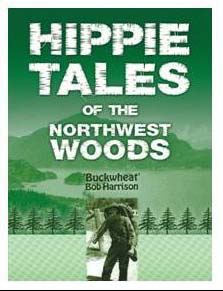
Book: Hippie Tales of the NorthWest Woods
Stories of the back to the earth movement of the 1970's and 80's covering 5 years in Southern Oregon and 10 years on Lasqueti Island.
One of these stories appears in the Lasqueti memoir of the time, "Accidental Eden".
Hippie Tales is available at Amazon, Barnes & Noble, and at your local book stores..
By Buckwheat Bob Harrison
bobharrison [at] mindspring [dot] com
(530) 532-4365
Is there a pack of free-roaming St. Bernards on island?
Yes.
And a gaggle of free-roaming children.
A herd of free-roaming sheep.
A band of free-roaming musicians.
A spade of free-roaming gardeners.
A palette of free-roaming artists.
A basket of free-roaming weavers.
And tinkerers of all sorts coming out of the woodwork.
Viral videos of all the above to appear soon on your facebook feed.
* Due to an overwhelming number of inquiries about a viral video featuring a pack of 40 St. Bernards roaming the woods, I've decided to completely muddy the waters. Remember -- if you saw it on the Internet, it must be true.
Emergency
Emergency Reporting Number
For all emergencies on Lasqueti Island, call
1-855-871-1175
or 250-954-4432
A call-taker will answer the phone and ask how to direct your call: fire, ambulance or police.
Fire Safety
Fire Danger Rating
MODERATE
Thursday August 21, 2023
Due to the recent rain we are back to moderate fire danger.
This means that the high risk activities ban is lifted. but we will still be using the early shift restrictions.
High risk activities must stop by 1300 each day and a 2 hour fire watch must be posted after work stops.
Please continue to be careful with your activities.
What the danger class ratings mean
Low: Fires may start easily and spread quickly but there will be minimal involvement of deeper fuel layers or larger fuels.
Moderate: Forest fuels are drying and there is an increased risk of surface fires starting. Carry out any forest activities with caution.
High: Forest fuels are very dry and the fire risk is serious. New fires may start easily, burn vigorously, and challenge fire suppression efforts. Extreme caution must be used in any forest activities. Open burning and industrial activities may be restricted.
Extreme: Extremely dry forest fuels and the fire risk is very serious. New fires will start easily, spread rapidly, and challenge fire suppression efforts. General forest activities may be restricted, including open burning, industrial activities and campfires.
https://www2.gov.bc.ca/gov/content/safety/wildfire-status/wildfire-situation/fire-danger
The full details can be seen here
https://www2.gov.bc.ca/gov/content/safety/wildfire-status/prevention/for-industry-commercial-operators/high-risk-activities
Denman fire has a good, plain language explanation.
https://denmanfire.ca/outdoor-burning/fire-hazard-rating-explained/
Lasqueti Volunteer Fire Department
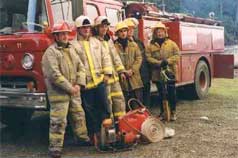
The Lasqueti Volunteer Fire Department (LVFD) is staffed by a dedicated crew of volunteers, including:
- First Responders
- Fire Fighters
- Emergency Response Coordinators
- Coordinators and administrative assistants
Our Fire Chief, Richard C., capably oversees the whole operation for the qRD.
The community is so grateful to these dedicated volunteers who take annual training courses and are on-call 24/7 during their shifts. You are an amazing group of people!
The annual Fire Fighters Picnic (typically in the first weekend of August) is the primary fund raiser for our volunteers, and one way we show our appreciation for all they do.
To dontate, please send cheque made out to: Lasqueti Volunteer Fire Department c/o
LVFD
General Delivery
Lasqueti Island , B.C.
V0R 2J0
Lasqueti Ferry
The ferry runs from French Creek Harbour on Vancouver Island to False Bay on Lasqueti Island. Pay parking is available at the marina. The trip takes from 50 minutes to over an hour (in rough waters). Passengers and freight only - no cars!

General Info
- Tickets are sold on-board, once the vessel is underway.
Simply board the ferry 15 minutes prior to departure (see Boarding Passes below). - No smoking anywhere on vessel - this includes e-cigarettes
(This is a BC Ferries policy - electronic cigarettes are considered to be smoking.) - All dogs must be on a leash.
- The ferry does not wait for buses arriving at French Creek.
- Sailings are generally canceled when winds exceed 40knots (check the marine weather).
- The ferry service is run by Western Pacific Marine for BC Ferries
- Ferry schedule & fares available from Western Pacific Marine
- Phone: (250) 333-8787
- Check Ferry's current location at MarineTraffic.com
Baggage & Freight
Personal baggage limits of 100lbs or 5 cubic ft. may include groceries, feed, or seed, but not hardware items such as chainsaws, etc. No dangerous cargo is permitted.
Freight capacity is limited. All freight and excess personal baggage must be approved by the crew prior to loading. Maximum freight length cannot exceed 14'6".
Kayaks are permitted, dependent on available space - arrive early, ready to load early, and speak with crew about space availability and loading procedures.
Freight traveling unattended must display owner's name - unidentified freight will not be carried. Unattended freight must be paid in advance or upon delivery.
Please check westernpacificmarine.com for freight rates. For bulk or heavy items, see Freight & Barges).
Boarding Passes
On the days of anticipated heavy loads, boarding passes will be hung on the posts at each terminal. Passengers must be on board ship 15 minutes prior to sailing to ensure passage (even with a boarding pass).
Overloads
If 10 or more passengers are left on the last sailing of the day, from either terminal, an extra run will be made. Passengers may be required to prepay their fare, which is non-refundable
Link to letter 12 Oct23 asking BC Ferries to open bidding for Lasqueti ferry service: https://lasqueti.ca/node/7388
The Centurion VII is a passenger-only ferry that can hold 60 passengers. Transport Canada certified, 75 gross tons. Built in 1985.
The Lasqueti Island Ferry service is operated by Western Pacific Marine, on contract from BC Ferries
The Centurion VII in dry dock for R&R, March 2008
Archaeological Heritage
Peering into Lasqueti's Past
Learn how to say Lasqueti's Coast Salish name: Xwe’etay
Click here to view some of the artifacts and sites found on Lasqueti
The archaeological record of Lasqueti, like that of many of the Gulf Islands, bears witness to the island’s rich indigenous heritage. And, consistent with other island communities, Lasquetians feel a deep connection to their island and its history. These web pages are designed both to pay tribute to our island’s ancient heritage and to protect this heritage through education.
What kinds of archaeological sites are on Lasqueti and where are they?
Living on an island means, by definition, that many people will have homes on or near the water. People today choose these places so they can easily access the ocean, which in turn offers transportation and communication routes, sustenance, and, of course, beauty. Ancient people chose to put their homes in the same spots for many of the same reasons.
Our archaeological surveys of the island and perusal of private artifact collections tell us that First Nations used much of the island in the past. Large sites representing permanent settlements are located in almost every bay on Lasqueti These sites are composed of large amounts of mollusk shells and minor amounts of other remains (animal bones, artifacts). In many cases, ancient people created expansive flat, house platforms on otherwise rocky, unlivable surfaces by bringing countless basket-loads of shell from the beach. If these were properly excavated, we would find the remains of 1000s of years of super-imposed floors of longhouses (with hearths, post holes, storage pits, etc.) on top of these constructed platforms. Based on artifact styles, these longhouse villages date sometime within the last 2000-3000 years.
In association with some of the larger seaside settlements on Lasqueti are fish traps where the ancient Lasquetians trapped and sometimes stored the abundant fish of Georgia Strait. Such ancient extraction and management techniques allowed for the relatively high density of ancient settlements on the island. Click here for more information on one Lasqueti fish trap and to view photos.
Indigenous peoples used the inland areas of Lasqueti in two ways. Based on the artifacts people find in their gardens, we can tell that people hunted deer and gathered berries throughout the island’s interior. The form of some of the projectile points suggests people have been camping in Lasqueti’s inland since 6000-8000 years ago.
The second use of the inland was as a retreat during times of conflict. These refuge sites are recognizable by shell located a considerable distance inland and up slope from some of the larger settlements. Such sites are usually on promontories with good visibility out to sea, but as much as 40m above the ocean. Based on archaeological work elsewhere in the northern Gulf Islands, such sites date to the last 1000 years or so.
To find out more about the island and the region’s rich past, read these articles from the Isle & Times about the archaeology of herring and obsidian or go to this web site http://www.sliammonfirstnation.com/archaeology/
The status of Lasqueti’s archaeological heritage
Despite the fact that Lasquetians generally have a strong connection to and respect for our island, we are doing a poor job of protecting our collective archaeological heritage. Not surprisingly, many of the island’s coastal sites were destroyed in the mid 20th century as a result of logging, other development, and early settlements. Since that time, however, with easier access to bulldozers and backhoes, and increasing demand for waterfront property, the rate of archaeological site destruction on Lasqueti has increased greatly. Unless we make a concerted effort as a community to slow down the destruction of sites, the record of Lasqueti’s deep history will be lost forever.
To find out more about the laws that protect Lasqueti’s archaeological sites and your rights and responsibilities if you have an archaeological site on your property, read these two Isle & Times articles from 2002 and 2005.
| Attachment | Size |
|---|---|
| Our Collective Heritage (pdf) | 69.69 KB |
| Call before you dig (pdf) | 83.4 KB |
| Care and tending (pdf) | 65.26 KB |
| Herring and archaeology (pdf) | 64.91 KB |
| Marshall fish trap (pdf) | 272.66 KB |
| Obsidian (volcanic glass) (pdf) | 79.8 KB |
| The Island in the Middle of Everywhere (pdf) | 49.68 KB |
| More on our Archaeological Heritage (pdf) | 70.09 KB |
| An Archaeologists View of False Bay (pdf) | 62.57 KB |
| Ancient Sea Level History (pdf) | 76.69 KB |
Lasqueti's Coast Salish name
In several Coast Salish Indigenous languages in BC, Lasqueti's name is Xweh et tay, meaning "yew tree".
Of this place name, the late Karen Galligos of Tla'amin First Nation shared that her Elders said this name refers to “a strong wood, a wood they used to make wedges” . According to Karen, the word “Xweth” is a wedge, and that the island has this name because of the abundance of iron wood (yew) trees.
Listen to the attached recording of Tla’amin Elder Dr. Elsie Qaxustala’s Paul saying Xweh et tay. With thanks to Tla’amin educator Gail Blaney.
If you're interested in other Tla'amin place names in the Salish sea visit https://powellriver.ca/pages/photo-history-of-powell-river
| Attachment | Size |
|---|---|
| Lasqueti place name (Elsie Paul Dec. 2020 (mp4) | 1.69 MB |
Xwe'etay/Lasqueti Archaeology project logo

Four herring surround two yew branches in the shape of a spindle whorl. Herring are included in this because of their significant presence in the Indigenous history of the land. The trowels inside the herring represent the archaeological part of the project. The yew tree holds significance for Lasqueti Island as the Coast Salish name for Lasqueti, xwe'etay, translates as Yew tree. The central red circle is the berry that grows on the branches of the tree. With the shape of the spindle whorl, we seek to weave together the strands of history left to us by our ancestors to better know their stories.
Jesse Recalma Xwulqsheynum created this beautiful Xwe’etay/Lasqueti Project logo. Jesse is a Coast Salish artist and a member of Qualicum First Nation and a project team member. He learned art by watching and listening to the stories of his grandfather. While carving is one of his favourite mediums, he also devotes his time to painting, Indigenous languages, and digital design. His works can be viewed on his instagram page instagram.com/saatlamarts or his facebook page facebook.com/saatlamarts
| Attachment | Size |
|---|---|
| Xwe'etay Archaeology Project Logo | 365.46 KB |
Au Naturale
Lasqueti is quite sparsely populated and lies in a rare ecosystem type - the Coastal Douglas Fir zone. Our famous herds of feral sheep, along with the unique history of settlement have resulted in an ecology and natural environment with its own character.
Many, professional and ametuer, have taken a keen interest in Lasqueti's Ecology, it's Natural Environment, its Flora and Fauna, its Ecosystems - in short, its Natural History. But not much of this wealth of information has made it on the site yet - what has, you'll find here. If you have something to contribute in this regard, Contact us.
Invasive Plants
Not every plant sold in a nursery makes a good choice for your garden or landscape. Some non-native plants find wild success in Lasqueti's climate and soils - so much so that they can spread uncontrollably, pushing out more sensitive species. Many of the following are mentioned at www.bcinvasives.ca as being invasive plants in BC. If you know of others, contact Terry at 8501. I am slowing working on this project , so forgive the incomplete information.
Invasive Species
| Common Name | Scientific Name | Description | Possible Alternatives | Photo |
|---|---|---|---|---|
| Bohemian Knotweed | Fallopia. x bohemica | Lush, bamboo-like with pretty feathery white flowers. 2-5m high. Among the most difficult plants to eradicate. |
Joe Pye Weed (Eupatorium purpureum). False Soloman's Seal (Maianthemum racemosum). Bugbane (Actaea ramosa and A. simplex). |
 |
| Butterfly Bush | Buddleja davidii | Hardy deciduous semi-evergreen shrub 4-5m tall | Red-flowering Current (Ribes sangunieum). California Lilac (Ceanothus thyrsiflorus). Oceanspray (Holodiscus discolor). |  |
| Common Periwinkle | Vinca minor | Forms dense mats & invades wet areas. Vinca major is less problematic. | Wild Ginger (Asarum caudatum). Piggyback Plant (Tolmeia menziesii). Christmas Box (Sarcococca hookeriana). |  |
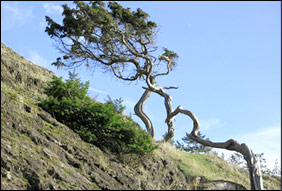
| English Holly | Ilex aquifolium | Large bush or small tree - spread by birds. Casts deep shade that deprives native plants of light, nutrients & water. | Holly-leaf Osmanthus (Osmanthus heterophyllus). Tall Oregon Grape (Mahonia aquifolium). San Jose Holly (Ilex x aquipernyi). | |
| English Ivy | Hedera hiburnica | Thick mats overwhelm plants on the forest floor and, smother trees. |
Deer Fern (Blechnum spicant). Salal (Gaultheria shallon). Barrenwort (Epimedium spp.). |
 |
| Giant Hogweed | Heracleum mantegazzianum | Stout, bright green tsem spotted with dark red.Small white flower clusters. Grows more than 2m. high. Sap causes blistering & scarring. |
Blue elderberry (Sambucus cerulea). Wild celery (Angelica archangelica). |
 |
| Giant Knotweed | Fallopia sachalenensis | Lush, bamboo-like with pretty feathery white flowers. 2-5m high. Among the most difficult plants to eradicate. |
Joe Pye Weed (Eupatorium purpureum). False Soloman's Seal (Maianthemum racemosum). Bugbane (Actaea ramosa and A. simplex). |
|
| Himalayan Blackberry | Rubus armeniacus | |||
| Himalayan Knotweed |
Polygonum polystachyum | Lush, bamboo-like with pretty feathery white flowers. 2-5m high. Among the most difficult plants to eradicate. |
Joe Pye Weed (Eupatorium purpureum). False Soloman's Seal (Maianthemum racemosum). Bugbane (Actaea ramosa and A. simplex). |
|
| Japanese Knotweed | Falliopa japonica | Lush, bamboo-like with pretty feathery white flowers. 2-5m high. Among the most difficult plants to eradicate. |
Joe Pye Weed (Eupatorium purpureum). False Soloman's Seal (Maianthemum racemosum). Bugbane (Actaea ramosa and A. simplex) |
|
| Policemen’s Helmet | Impatiens glandulifera | Grows 1-2m high with a soft green or red-tinged stem.Pink flower. Crushed foliage has a musty smell. |
Western columbine (Aquilegia formosa). Fireweed (Epilobium angustifolium). Red-osier dogwood (Cornus stolonifera). |
|
| Purple Loosestrife | Lythrum salicaria | |||
| Scotch Broom | Cytisus scoparius | Spanish Broom |  |
|
| Sweet Cicely | Myrrhis odorata |
Edible herb with anise flavour / smell. Very hard to eradicate - deep roots re-grow from small fragments. (see Wikipedia entry...) |
 |
|
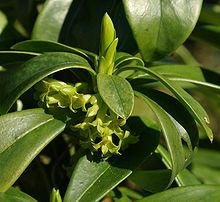
| Spurge Laurel (or daphne laurel, laurel-leaved daphne, olive-spurge, wood laurel, copse laurel) | Daphne laureola |
European flowering shrub. Spread rapidly by seed and root sucker. Poisonous and gloves must be worn when hand pulling to protect against the caustic sap. (see Wikipedia entry... ) |
|
|
| Yellow Archangel/Lamium | Lamium galeobdolon | |||
| Yellow Flag Iris | Iris pseudacorus |



Lasqueti Butterflies
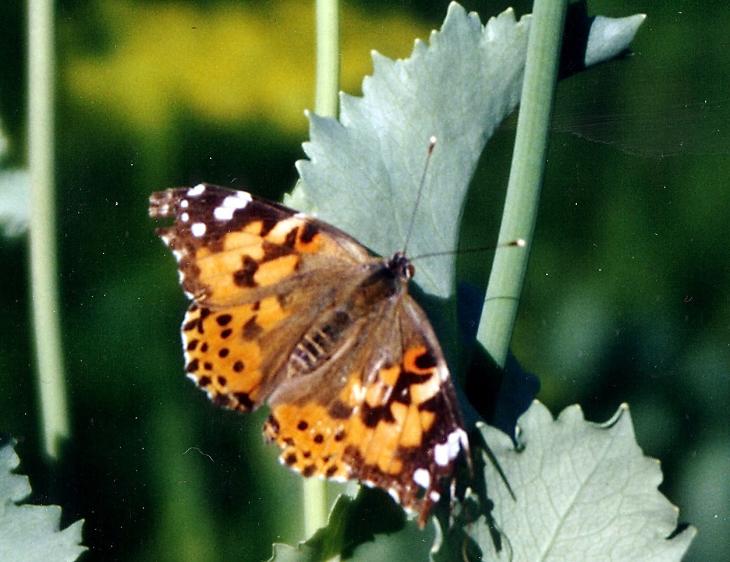
This site is for butterflies that have been seen and identified on Lasqueti Island.Over several years I have sent photos or butterflies I've found dead to Cris Guppy, the author of Butterflies of British Columbia, for positive ID and for his record keeping. Many thanks to Cris for his help and encouragement.
The information and photos are intended to help anyone who wants to get to know these local residents better and to appreciate their grace and beauty. They have truly marvelous lives and life cycles.
If there is no photo credit, I took the picture on Lasqueti. Otherwise, the photographers are credited, and the photos are used with permission.
BUTTERFLY CONSERVATION: The biggest threat to butterflies is habitat loss: to urban development (pavement, manicured lawns), intensive agriculture, logging (for a few species), and overgrazing by cattle and sheep. On Lasqueti we can encourage and preserve natural areas -- especially forests, sheltered forest glades, wet places and streams, brushy areas, and patches of nettles, willow, and alder, which are the host plants for many local butterfly species.
It is also important to avoid completely the use of herbicides and pesticides, including and especially Bt, which is widely sold as a mild way to control some pests but which is deadly to the larvae of all butterflies and moths.
If you do want to plant a butterfly garden, be sure the seeds you are sowing are for the butterflies that are or could be here. Most seed mixes sold for this purpose are primarily for the butterflies in other geographic areas. I have found that a general mix of flowering herbs, shrubs, annuals, and perennials seems to attract a lot. Host plants for the larvae are at least as important for species survival as nectar-producing flowers. Butterfly gardens are more for our pleasure at seeing the adults (I have seen 25 Painted Ladies at once on Lasqueti, in a large planting of lavender.).
Raising purchased butterfly larvae, or releasing butterflies at a wedding or other event, is not a good idea, as it puts non-native butterflies, or non-resident populations, into an area -- the same as Atlantic salmon escaping from fish farms into Pacific waters.
Moths and butterflies are categories of the insect order Lepidoptera, which comprises possibly a million species. Generally, butterfly antennae are thread-like, with a small club at the end. Moth antennae usually lack clubs and resemble either threads or feathers.
NO ROYALTY ON LASQUETI! People will sometimes refer to the "Monarchs" on Lasqueti, mistaking the two species of Swallowtail butterflies that are here for the famous and widely pictured Monarch butterfly. Swallowtails are white or yellow with broad black tiger stripes. Monarchs are orange, with thin black lines in a stained-glass pattern, not stripes. While it would be lovely to see these master-migrators on Lasqueti, they have only rarely been recorded anywhere on the coast. Their primary range is to the east or the south of us.
WATCHING BUTTERFLIES: Mostly, to watch butterflies, you just have to go to a likely habitat, in season, after the day's sun has warmed things a bit, and sit and be patient. You will notice many as you walk on the roads or woodland edges or in fields, or as you garden. A pair of close-focus binoculars is a wonderful tool for butterfly-watching. A few years ago these were out-of-reach expensive, but they are now being made for the popular market. If you are shopping for binoculars, be sure to check the focus range. If the smaller number is 2 metres or less, you're OK for butterflies.
I have seen butterflies in the usual haunts in and out of the garden, and also crossing bays and between islands. Since they sip water and minerals from various places, they may also be on beaches and tideflats, on piles of old seaweed, and on mud and animal dung. (Note: A greenhouse with the doors open can be a great butterfly-catcher, but if your greenhouse is trapping them, it is essential to check a couple of times a day and catch and free them. Gentle handling is fine, just be sure not to squeeze the body. We were catching so many, and not always finding them in time, that we now net the doorways.)
The more you observe, the more you'll see: courtship, mating, egg-laying, larvae, and pupae, as well as the beauty of the adults. If you notice an adult flying around host plants, some time spent watching could reward you with the sight of egg-laying, and then you will know exactly where to look later for larvae and pupae.
To learn more, in addition to watching, take a look at these books and websites:
Butterflies of British Columbia by Crispin Guppy and Jon Shepard. UBC Press, 2001. A big, definitive book.
The Butterflies of Cascadia, by Robert Michael Pyle. Seattle Audubon Society, 2002. A useful field guide to the butterflies of Washington, Oregon, and southern BC. Great photos, lively writing.
http://efauna.bc.ca Photos and extensive information about all types of animals in BC. Complete and easy to use. (There is a comparable eflora site for BC plants.)
www.butterfliesandmoths.org One of those US sites that define "North America" as stopping at the 49th parallel, but there are no butterflies in southern BC that do not also occur in northern Washington. Good photos.
Zero Mile Diet
Food self-sufficiency -- Eating well out of your Garden -- Tips on Local Gardening
A series of articles on year-round eating from the garden, by Sue Wheeler
These articles, arranged by month, are intended to pass on information to help us become more food self-sufficient by eating well out of the garden all year round. I will include tips I've picked up from my own and friends' experience, plus information I've run across that I haven't seen elsewhere. I don't plan to include info that is widely available in garden books and articles, such as how to grow squash or potatoes or other crops that are harvested in Fall and stored.
"Winter gardening" is really spring and summer planting for winter eating. It requires planning to be sure there is a place in the garden for the overwintering crops to go in at the right time. For example, when you plan where you'll plant carrots, allow space for spring planting of the summer carrots and also summer planting of the carrots that will be left in the ground and harvested through the winter and into spring. A bed that had the earliest peas and lettuces will be finished in time for the overwintered cabbages, broccoli, and cauliflower. I reserve a spot from the beginning of the season for kale and chard, which need to be seeded in the garden before any of the early crops are finished.
A good source of information is Linda Gilkeson's articles about winter gardening on the coast, which can be found at
http://www.saltspringenergystrategy.org/food.htm
Linda also has an excellent book, Year-Around Harvest, which can be ordered from West Coast Seeds, Salt Spring Seeds, at local bookstores, or through her website, www.lindagilkeson.ca
Another recommended book is Eliot Coleman's Four-Season Harvest, available at the regional library (www.virl.bc.ca)
Here is a table of what to plant when on Lasqueti (adapted from Linda Gilkeson's "Salt Spring Planting Dates" in her book Year Round Harvest)
WHEN |
WHAT TO PLANT |
Feb. or March |
Leeks |
|
April-May |
Celeriac, parsley, leeks, chard |
|
Early June |
Brussels sprouts, carrots |
|
Mid- to late June |
Purple sprouting broccoli, winter & over-wintering cabbage, parsnips, beets |
|
Early July |
Rutabagas, endive & radicchio, kale, kohlrabi, overtintered cauliflower |
|
Late July-early August |
Arugula, fall & winter lettuce, mizuna and other Asian greens, collards, kale, daikon and winter radishes, spinach, corn salad, basil (for transplanting to pots for a windowsill indoors in early fall)
|
|
Early August Late August to mid-September |
Over-wintered onions
Corn salad, cilantro, arugula, winter lettuce |
early October |
Lettuce and spinach in greenhouse |
April 2009
This week's article from Linda Gilkeson's email list is about hardening off seedlings. You can get on this list by emailing Linda at info [at] lindagilkeson [dot] ca. She lives on Salt Spring, so her tips are directly useful for us. You can read all her past articles at the link she cites below.
Quoting Linda:
How you harden off tender seedlings can have a long term effect on the crop. Hardening off is the process of reducing the growth rate of seedlings by exposing them to cooler conditions and less water and fertilizer. As their growth is checked, plants accumulate food reserves, which they can use to produce new roots faster when they are transplanted. Hardening off also thickens the cuticle and wax layers on leaves, which helps plants to withstand wind and weather and protects leaves from sunburn.
Some plants can be hardened off to withstand frost, including the cabbage family, lettuce, most greens and onions. If transplants plants are too large, however, exposure to temperatures under 5-10oC for more than a couple of weeks can make some of them send up seedstalks.
The tricky thing is that there is a disadvantage to over-hardening plants. Such plant are slow to begin growth and may never really recover, resulting in lower yields and later maturing crops. Transplants suffering from uneven watering, from being rootbound or chilled become over-hardened. Plants for sale have usually been hardened off by the time they reach the market so they become over-hardened if they hang around too long before they are set out. [Find out when your local nursery brings in new stock, buy your transplants the day they arrive and plant them out immediately or else pot them on]. Home grown seedlings that were started too early suffer the same fate if they end up being held too long in small pots.
Hardening off is least helpful for tender plants, such as tomatoes, peppers, cucumber, melons, squash, and celery. Ideally, you want to time the seeding date for these so that transplants reach the right size to go into the garden just as the weather becomes warm and stable (good luck with that!). Such tender plants are better off being started later rather than earlier so they don’t experience a check in their growth. In any case, if seedlings are becoming rootbound and the weather still isn’t warm enough to put them out, they should be potted in larger containers and kept in.
Hardening off for tender crops mainly means getting them used to direct sunshine. Tender plants that have been started under glass can be seriously damaged or even die from sunburn if suddenly moved outdoors (really!). Sunburn damage on cucumbers and squash (the most susceptible group) appears as light tan spots and blotches on leaves and stems.
What to do: Gently harden off transplants you have grown by gradually exposing them to direct sun and outdoor conditions. Starting with an hour or so the first day, set them out for a longer period each day, taking about a week to get them used to a whole day outdoors. Move them indoors if nights are cooler than normal. Once they are set out, keep sheets of plastic, floating row cover, cloches or other covers handy to protect transplants from an late cool spell.
May 2009
WHAT TO PLANT THIS MONTH: It's not too late to plant leeks, for harvest through the winter and into next May. Parsley planted now will last over the winter in the garden, barring three weeks under heavy snow (and even then it did come back from the roots) And it's not too late to start celeriac indoors, for transplanting into the garden when it's truly warm later in the month. It will last through next April.
First week of July
This week: last chance to plant beets, carrots, and rutabagas for late fall/winter harvest. If it's hot, a cover of burlap or newspaper will help keep the seedbed moist until the seeds sprout (Remove this as soon as they have sprouted).
This is also the time to plant seeds for overwintered cauliflower, to be harvested next spring. If you didn't get seeds for this crop this year, make a mental note to get them when you order seeds next winter. It's the sweetest cauliflower you will ever taste, and great to have at that time of year.
Look for and prepare a place where you will be able to sow hardy greens in a couple of weeks-- chard, kale, arugula, spinach, Chinese cabbage and other Asian greens.
Early August
The arrival of August shift us into the next phase of planting for winter eating. August 1st is the halfway point between Summer Solstice and Fall Equinox-- Lammas, in the Celtic and old British calendars, a harvest festival in which bread baked from the first wheat harvest of the year was blessed. Bread blessings sound good to me! The shortening of the days means that seed can be sown for overwintered onions (Onions are sensitive to day-length and might bolt to seed too early if planted sooner). Walla Walla is the main variety grown in this area-- a large, delicious onion that will be ready for harvest around July 1st next year (OK, it's not exactly winter eating, but it does fill the gap left by the last of the stored onions, before next year's crop will be ready). Seed a few rows in any spot in the garden, cover with a little protection against the worst winter weather, then transplant next spring into that year's onion area.
You can sow all the Asian greens now for fall harvest, plus fall and winter lettuces, arugula, kale, winter radishes, spinach, scallions and corn salad. Corn salad, also known as mache ("mosh"), is especially hardy, and works well as a cover crop as other things get harvested.
Tips for seedling survival in hot weather: If your soil dries especially quickly, so that daily watering is not enough to germinate seeds, try covering the seeded area with cloth or a couple of layers of newspaper. Check each day and remove as soon as the seeds have sprouted. After this, to shelter the babies from too much sun, I've been using upturned bedding plant trays, those lattice-work black or grey plastic trays that a dozen or so small pots come in from nurseries. They let in about 50% of the light. They turn up at the Free Store, or maybe a neighbour has a few spares, if you don't have any. Shade cloth would work, too.
Early September-October
The best time to plant for fall and winter eating may have just passed, but if you haven't been able to do it yet I'd suggest going out there right now and sowing some lettuce, arugula, spinach and corn salad, especially if you have room in the greenhouse or a cold frame or any other place you could shelter after the weather turns. It is probably not too late to plant cilantro, which is surprisingly hardy-- one Lasqueti gardener had hers survive outside last winter, with no protection, through all that snow and cold. If you can get transplants from a neighbour, or find plants for kale, Asian greens, or lettuce at a nursery, that would put you a couple of weeks ahead of direct seeding.
Through early October you can sow lettuce, spinach, arugula, and Asian greens, under a cold frame or in a greenhouse, that will germinate and stay small through the winter and begin to grow quickly when the days lengthen in February, giving you salads in the early spring, before you need the greenhouse for tomatoes etc. Whatever you do, be sure to get cover crops on the bare patches in the garden as they appear after harvest. If you are able to do only one thing for your next year's garden, this is the best. Make a note of the fall and winter crops you wish you'd gotten seed for this year, for next year's seed ordering. The whole schedule of what to plant when is on the main page of the Zero Mile Diet site.
History
Lasqueti HAS a history....
There is evidence of human habitation stretching back thousands of years - fortunately, we have a resident archaeolgist who has been documenting Lasqueti's Archaeological Heritage
Elda Copley Mason published a book on it in 1976, documenting the early days of settlement and homesteading - Lasqueti Island: History and Memory
Pat Forbes also wrote an account - So You Want to Know about Lasqueti? available at Crystals & Chamomile
The Gulf Islands Guide has a nice little article on it: www.gulfislandsguide.com/history/lasqueti.htm
Doug H. and Darlene O. recently published Accidental Eden: Hippie Days on Lasqueti Island documenting the "back-to-the-land" invasion during the 1970's and 80's.
... is there anyone who wants to take on the project of developing a Lasqueti history e-book the whole community can contribute to?
Forest History
Lasqueti lies in the Coastal Douglas Fir zone, a now rare ecosystem that supports towering old growth. These forests have been logged heavily, and Lasqueti is no different, with a century-long history of small-scale and industrial logging.
Dick Varney is a local forester. His research into pre-settlement forest conditions and the history of logging on Lasqueti is presented in the subpages here.
Lasqueti past forest conditions: 1875 survey
This series of articles were published for the general public to increase knowledge of historical forest conditions, with emphasis on Lasqueti Island (Xwe?etay/Xwe”i”tay). Most of it will also apply to the whole CDF and parts of the dryer CWH areas. The forest conditions do not only mean trees; grasses and openness were also part of the landscape condition.
As I get more information, I continue to reassess my historical forest conditions knowledge and learn. I made a spreadsheet of Carey’s 1875 legal survey information from which to do some analysis. Here are some draft results. This should allow us to understand forest conditions in 1875. Any mistakes are my fault in either the spreadsheet or my analysis. I used survey page numbers within the spreadsheet to make it easier to check; I have already found some mistakes in my fist draft. I found it hard to accurately transcribe old notes, both onto a spreadsheet and even to Carey’s closing remarks. My spreadsheet is available to anyone for use and I would appreciate any corrections if found.
... Please see the attached PDF for the complete report ...
| Attachment | Size |
|---|---|
| 1875 Survey Analysis (PDF 21) | 699.48 KB |
Logging History
Logging history of Lasqueti (Xwe?etay/Xwe”i”tay)
While doing my research on pre-settlement CDF forests, I picked up a lot of additional information about historical logging and logging on Lasqueti. Much of the logging history of Lasqueti needs to be interpreted from other areas, because I have found little direct information.
This report documents:
-
First Nation use
-
Rat Portage Timber lease
-
Machinery used by Rat Potage/Hillis Logging
-
General Logging history
-
Johnny Osland and local oral history
-
Other patterns from logging
-
Summary of logging on the Unceded lands/Crown Lands
And covers periods:
- pre-1920
- 1920 - 1940's
- 1947 - late 1960's
- 1976 - present
... Please see attached PDF for complete report ...
| Attachment | Size |
|---|---|
| Logging History on Lasqueti (pdf) | 343 KB |
Pre-settlement Wildfire information
I write this to get us all thinking about our goals/visions and options (how to achieve our goals) about our forests. For more than ten years I have been studying “What were our CDF pre-settlement forests like?” off the side of my desk. I’ll start with a hypothesis: Lasqueti forests were more open (less dense), multiple aged and diameters, less brush, created by active management with fire, experienced/used to frequent ground fires, often with small patch to larger prairie areas of forbs/forage and of coarse stands of nice old-growth trees. The northern Coast Salish frequently burned Lasqueti (Xwe?etay/Xwe”i”tay) to increase both wanted plant & fauna habitat for their food needs on the island. I believe such a forest (pre-contact) can be burned relatively safely (without crowning out and killing all/most of the trees) and would be at a lower wildfire risk than what we have today.
If this hypothesis is correct, then our present forest is quite different; much denser, lots of fuel, filled with fire ladders, and too many crowns touching one another; in other words, just waiting for a major stand replacing fire to happen. Like what has been occurring up & down the west coast. The fire return was from about 6 to 45 years, which increases our wildfire risk with each additional decade without a fire. We need a to thin out the forest and possibly re-introduce fire by controlled burns, to protect our forests. This presentation is the first (part 1) about the pre-settlement CDF forest and is mostly about the time between wildfires and the mix of what old-growth was like on the island from my research.
... Please see attached PDF for full report ...
| Attachment | Size |
|---|---|
| CDF and fire (PDF) | 686.13 KB |
Local Governance
Local Governance
Three distinct local governance bodies regulate vaious aspects of life on Lasqueti:
- Islands Trust - local land-use, OCP, development, and environmental planning
- qathet Regional District - services and by-laws
- School District 69 - False Bay School
Democracy Corner
This series of articles is intended to help increase our collective understanding of how local government, especially our regional district, is supposed to work for us -- what is their role and what is the process they use to make decisions.
Why is process so important?
I learned the importance of democratic process when I was a municipal councilor in Highlands, and dealing with the largest development in BC at the time (Bear Mountain - part in Langford and part in Highlands). I was exposed first-hand to risks to our democracy (involving conflict of interest, a lawsuit, a murder charge, and a tiger …).
Learning to understand and use the tools available (e.g. the Local Government Act) was critical to reaching an acceptable option (which involved the entire Capital Regional District – 13 municipalities and 2 electoral areas, and a provincial-appointed mediator and arbitrator). I also learned from being the Highlands representative on the CREST Board (Capital Region Emergency Service Telecommunications), the Regional Arts Council, and chair of the Highlands Emergency Preparedness Committee.
Democratic process may seem boring and tedious (which it is), but it is essential to our community well-being. You don’t have to look far to see risks to democracy.
One of the main ways that democratic process can go off track is if people do not know how it is supposed to work.
Over the past couple of years, it has become clear to me that there is some uncertainty about how regional districts are supposed to function, and the role of regional directors.
Even the PRRD itself seems to have some misunderstandings. Last spring, after I pointed out a case in which staff had not applied proper process, my complaint was acknowledged and the process was corrected, but PRRD Chair Brabazon also wrote to me “Those who seek some deep, dark, conspiracy to subvert the democratic process are looking for something that is not there.”
Poorly understood and applied democratic process by all parties can lead to conflict.
How Regional Governments are Supposed to Work
In the collection of articles below, I draw on my experiences as a municipal councilor in the Highlands and on the various regulations and acts that enable our Regional District to make decisions and provide services to their constituents.
I hope you find these useful.
Andrew Fall
Regional districts: representative democracy
How are regional districts supposed to function, and what is the role of regional directors?
Regional districts, municipalities and the Islands Trust were created by the provincial government, and exist mainly under the Local Government Act and the Community Charter.
The provincial “Primer on Regional Districts in British Columbia” (https://www.regionaldistrict.com/media/28095/Primer_on_Regional_Districts_in_BC.pdf) explains some of the fundamental principles that underlie regional districts, including:
- “Regional districts are federations of municipalities and electoral areas. As such, they represent a balancing of two contending needs for accountability – accountability to the municipal members and accountability to the public.”
- “representation for electoral areas comes from directly elected directors”
- “Accountability to citizens is achieved at the general local government elections but also through on-going opportunities for the public to be involved.”
- “the board is a forum for inter-municipal cooperation and not a separate government”
- “Regional districts are for the most part voluntary organizations .... they only provide the services that their members or their residents agree they should provide.”
- “Regional districts are for the most part consensual organizations ... they only do what their municipal members and the public agree they should do.”
- “extensive procedures are set out in the Local Government Act for obtaining consent of the member municipalities and, in the case of rural areas, elector assent, whether in the form of referendum, petitions or counter-petition”
- “Each regional district provides services appropriate to its circumstances.”
- “regional districts require a close matching between the benefits and costs of services. The intent is that residents ‘pay for what they get’”.
Regional districts are a form of “representative democracy” founded on the principle of elected officials representing a group of people (as are most Western-style democracies).
In a representative democracy, the people vote for representatives, who then vote on policy initiatives. The foundation of representation is that the elected representative identifies the will of the majority of their constituents. If the desires of the community differ from their own personal view, they ought to put aside their own interests to advance those of the community as a whole (i.e. listening more than telling).
In our case, we elect a representative to sit as a director on the PRRD board. As our representative, for any major issue, he/she is supposed to identify and advance (i.e. represent) the will of the people.
I would be interested to hear other perspectives - please feel free to comment below.
Regional districts: who is represented?
Who are regional directors supposed to represent?
In a general sense, a regional director represents their electoral area (in our case, Lasqueti).
But who specifically does that include?
The “electors” are people who can vote in a local government election for regional director (next election: Oct 2018). Part 3 (Electors and Elections) of the Local Government Act defines who can vote:
- Resident electors are people who are 18 years or older, Canadian citizens, residents of BC for at least the prior 6 months, and residents of Lasqueti for at least the prior 30 days.
- Non-resident property electors are people who are not resident electors, but are 18 years or older, Canadian citizens, residents of BC for at least the prior 6 months, and owners of property on Lasqueti for at least the prior 30 days. Plus: only one owner of a property can register as a non-resident property elector.
But who is represented? Whose interests are we talking about?
In a nutshell: every resident and landowner (not just electors/voters).
The Local Government Act and the “Regional District Tool Kit” make it clear that our regional director represents the “jurisdiction” (i.e. Lasqueti). Although not every resident and property owner can vote, all need and deserve representation, and all have interests in how regional services are established and run on Lasqueti. This includes minors, permanent residents, and citizens of other countries.
Every resident and property owner is free to voice their support, concerns or wishes by writing or speaking to their regional director, by writing to the regional Board, or by attending Board meetings.
PRRD staff undermined this representation when they declared our petition in 2015 to be “invalid”. Recall that the community sent a petition with over 100 signatures to our regional director, asking him to put forward a motion to rescind 3rd reading of the 911 and house numbering bylaws. This petition was open to any resident and property owner.
Instead of our director acting on the petition, PRRD staff declared that it was invalid using a formal “certification of insufficiency.” However, this certification erroneously relied on the part of the Local Government Act regarding “petitions by property owners for a new service” (discussed in the note on regional service establishment). When I wrote to the PRRD CAO that our petition was not asking for a new service, his reply included that “the petition falls into a black hole.” In actuality, the petition was entirely valid, from the people who are supposed to be represented, and was improperly dismissed as invalid.
Whether or not you can vote, the regional director is supposed to represent all residents and property owners of Lasqueti.
Regional districts: how are new services established?
Lasqueti receives a number of regional services via PRRD, including the fire department, solid waste management, barge ramp, library, regional parks, etc.
How are regional services established?
Recall from the provincial “Primer on Regional Districts in British Columbia” (https://www.regionaldistrict.com/media/28095/Primer_on_Regional_District...) that regional districts are for the most part voluntary and consensual organizations. Regional districts are designed to only provide the services that their residents agree they should provide.
The Local Government Act codifies these principles in law in Part 10 (Regional Districts: Service Structure and Establishing Bylaws), Division 4 (Approval of Establishing Bylaws).
In general, new services must be “approved” by Lasqueti in one of four ways (section 342):
- A referendum with at least 50% of the votes in favour (section 344: approval by assent of the electors).
- A “counter-petition” with no more than 10% of the electors against (section 345 and Community Charter section 86). This “alternative approval process” can only be done for certain types of services.
- A petition signed by owners of at least 50% of the parcels and at least 50% of the land value (section 337). This also requires consent in writing by the regional director or a 2/3 vote by the Board.
- Consent by the regional director on behalf of the electoral area in writing (section 347) for certain services, provided the service does not require borrowing.
The North Island 911 dispatch system would require two new regional services for Lasqueti: house numbering and 911 emergency telephone service. As these services already exist for other areas in the PRRD, the PRRD tried to establish these on Lasqueti by amending the establishing bylaws (section 350) and passing the first 3 readings of the amendments at the Dec 17, 2014 Board meeting. This means the PRRD Board has approved them in-principle and adoption now hinges only on a single vote by the Board for final reading.
Approval from Lasqueti was done by “consent on behalf of Lasqueti” by our regional director, Merrick, without any prior community consultation. This consent may have followed the letter of the law, but did not follow the foundational principle that regional districts are supposed to only provide the services that the community agrees they should provide (i.e. consensual and voluntary).
What should have happened in a well-functioning, representative democracy? Consent from our regional director should only have been granted following meaningful community consultation of the new "proposed services", and after he received a clear mandate from the community to request the new services. Given that the Lasqueti community has so overwhelmingly objected to the new services, the consent granted by our regional director should not have occurred.
Regional districts: service withdrawl
Regional District service withdrawal can only be initiated by regional director.
The Lasqueti Island Volunteer Fire Department operates as a “regional service.”
During the past couple of years, PRRD representatives and staff have made multiple statements that the PRRD may take away this regional service.
For example:
- “if by the end of 2018 we are unable to show significant forward movement then I will likely recommend the board consider rescinding this service bylaw. ... I would argue that 9-1-1 service is a valuable service even if you don’t have a local fire/FR service...” (PRRD staff Thoms, Nov 2016)
- "We'll either do it properly or not at all" (PRRD Chair Brabazon, July 2017, Powell River Peak)
- “I think it would not be advisable for Lasqueti to stubbornly insist on Option C if it means rejecting RD support for our Emergency Services.” (Merrick, July 2017)
- “...we are in real danger of losing the service if we carry on dithering about dispatch while all else sits in limbo.“ (Merrick, Nov 2016)
The Local Government Act lays out the process by which a regional service may be “withdrawn” in Part 10 (Regional Districts: Service Structure and Establishing Bylaws), Division 6 (Dispute Resolution in Relation to Services), sections 361-372. The basic steps include:
- To initiate service withdrawal, a participant must give written notice to the Board, to all other participants in the service, and to the Minister.
- If there has not been a “service review” in the past 3 years, then a service review must first be done.
- The Minister must either require a service review, further negotiations, mediation or arbitration.
Key points, according to my understanding:
(a) The PRRD cannot start the process to withdraw our fire department service unless the Lasqueti regional director makes the request (as the “participant” representative).
(b) The service withdrawal process is overseen by the Ministry. Given that the majority of residents want to keep the regional fire department service -- according to the 2015 PRRD survey (> 90% of responses) -- it seems unlikely that the Minister would take a favourable view if the Lasqueti director were to initiate this process against the wishes of the community.
This is consistent with the consensual and voluntary nature of how regional districts are supposed to provide regional services.
This leaves a question: would our current PRRD director, and any future PRRD directors, publicly commit to NOT initiating a withdrawal of our fire department service without majority community support? If so, withdrawal of our regional fire department service cannot happen.
Regional districts: a 9-1-1 service cannot be withdrawn
The previous note described how only the regional director, following the will of the people he/she is supposed to represent, can initiate a withdrawal from a regional service (not the PRRD Board or staff).
There are, however, some services from which service withdrawal is impossible.
The “Regional District Service Withdrawal Regulation 398/2000” exempts 4 services from withdrawal:
- an emergency telephone system, including an emergency 911 system;
- a transit service;
- a regional parks service; and
- solid waste and recycling regulation, storage and management.
This means that, if the PRRD imposes a 911 service on Lasqueti, against the wishes of the majority of the community, then it would be impossible to withdraw from that service, even if we later found that our locally-designed solutions would work better.
When I brought the “No Withdrawal” regulation to the attention of the PRRD staff, the response from the CAO included:
“Creatively thinking, I suppose there is one way out of the 911 service. That would be to dissolve the fire department. With no fire department it could be logically reasoned that there is no need for a 911 service.” (PRRD CAO Radke, March 2015).
An alternative staff perspective was “I would argue that 9-1-1 service is a valuable service even if you don’t have a local fire/FR service” (PRRD staff Thoms, Nov 2016).
These responses do not seem very logical given that the majority of residents and landowners want to keep our regional fire department service (> 90% of responses in the 2015 PRRD survey).
The inability to withdraw from 911 is part of the rationale in the E-DAC recommendation for a 5-year review after implementing the locally-developed and supported Option C dispatch system.
If, after 5 years, the community, fire department and PRRD agree that the system should transition to a 911 system, then that would be possible. Conversely, if 911 is imposed on the community, and after 5 years, we realize that our Option C would have been better, tough luck.
The Option C dispatch system was developed with effort to consult with the community and fire department, as well as to meet the requirements, in order to best meet the interests of all stakeholders. Regional districts are supposed to provide the services that the community wants. Regional districts are not supposed to force services upon communities, especially a service subject to the “No Withdrawal” regulation.
Regional districts: enlightened self-interest
Whose interests are regional directors supposed to represent?
The Union of BC Municipalities (UBCM) and the BC Ministry of Community Services “Regional District Tool Kit” includes a comprehensive set of fact sheets and guides.
Discussion Guide 1 (Regional / Local Interests) addresses the question “Whose interests should directors promote at the board table?”
Some relevant quotes (described in the tool kit as the principle of “enlightened self-interest”):
- “Underlying the regional district model is the principle of self-interest, which maintains that a jurisdiction’s decision to participate in services that are provided through the regional district should be based on the jurisdiction’s own interest.”
- “In all, there will be many instances when a jurisdiction’s own, local interest is furthered by the willingness of its regional board representatives to compromise and collaborate with others to pursue regional initiatives. In these instances, however, local interests are not being compromised for the benefit of the broader regional community.”
- “The true test comes when a jurisdiction’s interest, as understood by its director(s), is not furthered by initiatives that are deemed by others to benefit the region as a whole. In these cases, whose interests should the director promote? The principle of self-interest, as described here, appears to suggest that the director should act on the interests of his or her own jurisdiction.”
My understanding is that our regional director is supposed to promote the interests of our jurisdiction (Lasqueti), while also aiming to cooperate to meet regional goals. This “enlightened self-interest” is consistent with the consensual and voluntary nature of regional districts as representative democracies.
Contrary to the UBCM/provincial principles, some within the PRRD seem to believe that a regional director should prioritize regional interests over local interests, as indicated by two agenda items on a recent PRRD agenda (Aug 17, 2017):
- “Which hat am I wearing now” by E. Mina was written for local vs. national interests. The original article was modified by someone in the PRRD to change “global” to “regional”. I checked with the author and verified that references to bylaws and legislation requirements weren't applicable to regional districts.
- “Supporting the Board Decision” by G. Cuff was written for municipal councils.
These two items suggest that global/council interests should take precedence over local interests. However, neither are fully applicable to regional districts because regional districts are not a separate level of government (they are federations of municipalities and electoral areas). The role of regional director is different from an MP, MLA and municipal councilor.
This distinction is crucial when there is a conflict between local and regional interests. Enlightened self-interest indicates that the Lasqueti regional director should give precedence to Lasqueti interests, with consideration for regional interests, and not prioritize regional interests over Lasqueti interests.
Regional districts: individuals are immune from legal action in their duties
Simply put: PRRD regional directors, employees, officers and volunteers are protected from legal actions related to their duties.
The Local Government Act lays this out in Part 18 (Legal Proceedings in Relation to Local Governments and Other Authorities), Division 2 (Immunities and Indemnities).
Section 738 (Immunity for individual local public officers) defines “local public officers” to include regional board directors, officers and employees of the regional district, volunteer firefighters, volunteers under the supervision of an officer or employee of the regional district, and regional district committees.
Section 738 states that no action for damages may be made against a local public officer or former local public officer related to their duties in their role as a local public officer, except if they have acted with dishonesty, gross negligence, malicious or wilful misconduct, or defamation (libel or slander).
This legislation directly contradicts the message recently conveyed by our regional director.
In the Sept 13, 2017 Lasqueti email list, Director Anderson wrote “NI911 will offer Lasquetians and the Board of the Powell River Regional District protection in the case of litigation. Who are the volunteers that are willing to put their personal lives at risk should an error occur?”
In fact, the implication that individual Lasquetians and PRRD Board members may be held personally liable if NI911 is not implemented is simply not true.
Regardless of which dispatch system is used, Section 738 of the Local Government Act guarantees that our volunteer Fire Chief, firefighters, dispatchers and First Responders can rest assured that they are not taking on personal liability risk by volunteering for the department. Same for everyone else involved in our recent interactions with the PRRD (e.g. volunteers on advisory committees, regional board members, and PRRD staff).
LIVFD volunteers fulfilling their duties, using the tools and resources provided, are PROTECTED and IMMUNE from legal action related to their duties. Plain and simple.
Regional districts: policy decisions are protected from liability
Disclaimer: The following is intended for educational purposes, and not as legal advice.
“Policy decisions” by the PRRD include financial decisions (e.g. the annual budget), changes to regional services (e.g. supporting dispatch Option C), and other issues that set “policy direction.”
Bylaws that define regional services are policies, as distinct from the operational implementation of those regional services (e.g. the service establishment bylaw that defines the LIVFD as a regional service vs. the on-the-ground implementation of the Lasqueti fire department).
According to the PRRD lawyer in 2015: “Policy decisions based on budgetary and public policy considerations are protected and immune from tort liability."
What is “tort liability”? A tort is a wrongful act that causes someone else to suffer a loss or harm (a “civil wrong”). Tort liability is the resulting legal liability for the person or entity that commits a tort. In the case of the PRRD, it is the PRRD corporation that would be held liable for any such legal claims (because individuals are immune as explained previously).
Protecting policy decisions of local governments from liability makes sense, and is what I understood as a municipal councillor. As long as a policy decision meets legal requirements, it needs to be protected from liability, otherwise regional districts and municipalities would operate under continual risk of legal action by members of the public or corporations that do not agree with their decisions.
The Municipal Insurance Association of BC describes liability risk in the context of a building inspection service, much of which is generally applicable (http://www.miabc.org/docs/default-source/Risk- Management/municipal-liability-for-building-inspection.pdf):
- (a) “Public authorities are tasked with acting for the benefit of a diverse group of constituents, but do not have unlimited resources to do so. In recognition of this unique position, the law distinguishes between “policy” decisions by governmental authorities and the “operational” implementation of those decisions. A true policy decision by a governmental body is not subject to review by the courts and will not give rise to liability in negligence. However, there may be tort liability for negligent implementation of policy (i.e. for negligent “operational” activities).”
- (b) “The Supreme Court of Canada has ruled that true policy decisions involve financial, economic, social and political factors or constraints. Operations, on the other hand, are concerned with the practical implementation of the formulated policies.”
- (c) “Since policy decisions will be immune from review, local governments should, when making decisions of general application, make a record showing the decision was a policy decision reflecting social, economic, financial or political factors and was properly considered.”
It is important to distinguish policy and operational decisions, since policy decisions are immune from liability, but liability may arise when implementing a policy decision (a topic of a future note).
As put in Just v. British Columbia, the government “must be free to govern and make true policy decisions without becoming subject to tort liability as a result of those decisions”.
Regional districts: operational decisions are not protected from liability
Disclaimer: The following is intended for educational purposes, and not as legal advice.
Policy decisions are immune from liability, but operational decisions are not.
To understand how this applies to regional services, it is important to understand the legal distinction between policy decisions and operational decisions. “The dividing line between ‘policy’ and ‘operation’ is difficult to fix, yet it is essential that it be done” (Just v. British Columbia).
Generally, operational decisions relate to “the practical implementation of the formulated policies, it mainly covers the performance or carrying out of a policy” (Brown v. British Columbia). That is, policy decisions relate to the course of action chosen (i.e. policy direction), while operational decisions relate to how that course of action is carried out.
Some examples from court judgements may help clarify:
- A system of lighthouse inspection is policy (including frequency of inspections or even no inspections); performing a specific inspection of a lighthouse is operational.
- A system of ice removal from roads is policy (including choosing to implement a summer schedule in November); removing ice on a specific section of road is operational.
- A system to identify and remove hazardous trees along roadsides is policy (even if it is unwritten, inspection is done by a civil servant who is not an arborist, and only a fraction of the identified trees are removed); carrying out the identification and removal of hazardous trees is operational (given the budget and resources allocated).
- A system of danger rock removal from highways is policy (including decisions to postpone treatment); treatment of highway sections with falling rock danger is operational.
- A system to respond to fires is policy (including dispatch, use of maps, and use of professional and volunteer firefighters); following that system in response to a specific fire is operational.
To minimize liability risk, operational decisions must be reasonable. “Where, ultimately, the contested decision is operational, the standard tort analysis applies, and the requisite standard of care is one of reasonableness” (Gobin v. British Columbia).
My understanding of how this applies to dispatch Option C: Policy decisions include choosing to use a call centre, and the choice of procedures for (i) the call centre to handle calls, (ii) volunteer dispatchers to follow in response to calls, (iii) use of the locally-developed mapping tool to locate incidents, and (iv) use of locally-implemented VHF repeaters. Operational decisions relate to how those items are carried out. The most important actions to limit liability risk would be following the procedures established, within the limits of the policy decisions and resources allocated.
The PRRD can set any reasonable policy without liability risk because policy decisions are protected from liability (http://lasqueti.ca/democracy-corner/liability-protections). Our volunteer dispatchers, fire fighters, and first responders are also immune from liability when conducting their operational duties (http://lasqueti.ca/democracy-corner/legal-immunity). One of the call centres we have checked out handles emergency calls for other communities in BC. Procedures can be established to ensure that the policies can be operationally carried out. Based on my understanding, the Option C dispatch system simply does not create a significant liability risk.
qathet Regional District: A case study of democratic process at the qRD
How Well did E-DAC Serve our Fire Dep't and Community?
In the Sept. 2018 issue of Our Isle and Times, Merrick asked “people to reflect on how well the EDAC committee served our beleaguered dispatchers and our Fire Department.” This is a good and relevant question and, as the former chair of the Emergency Dispatch Advisory Committee (E-DAC), I thought that it would be useful to provide some background facts and current status.
- E-DAC was created by the qathet Regional District (qRD) in early 2016 to explore, evaluate and recommend solutions for the dispatch system used by the Lasqueti Island Volunteer Fire Department (LIVFD).
- There were 9 members: 5 were members of the LIVFD (including the Fire Chief and head dispatcher), and 2 were former Fire Chiefs.
- E-DAC met 18 times over 10 months, held two public forums, researched options, and contributed hundreds of hours of volunteer effort.
- The qRD provided no budget for E-DAC, and the approx. $1,000 expenses for travel and product evaluation were covered by donations.
- E-DAC identified the values and interests of the community (from public forums), the LIVFD (from a dep’t meeting) and qRD (from their terms for the committee).
- E-DAC spent considerable effort to design local solutions that balanced the interests of the community, LIVFD and qRD. The E-DAC evaluated and compared the current system, the North Island 9-1-1 system and 3 locally designed solutions.
- At the well-attended 2nd public forum, the participants were in unanimous support for a local solution (Option C). At a meeting, LIVFD dispatchers agreed unanimously to support this option. E-DAC subsequently voted unanimously to recommend Option C.
- E-DAC delivered a comprehensive 300+ page report in Dec. 2016 that met the terms set by the qRD (see http://www.e-dac.ca).
The E-DAC final report included 4 recommendations to the Regional Board:
- To support LIVFD implementing the locally-designed Option C.
- To support LIVFD creating a fire dep’t support committee to allow members of the public to help the LIVFD Fire Chief and dep’t members.
- To support LIVFD completing and deploying the Incident and Resource Locator Tool, which had such strong support that E-DAC voted unanimously that this tool should be adopted with any dispatch system.
- To lobby Telus to ensure reliable telephone service.
The Fire Chief has initiated the fire dep’t support committee. So far, it has helped with some reporting and the picnic, and it will evolve as more people volunteer to help.
Further GPS data collection is being planned to advance the mapping tool, which was considered to be critical to the Lasqueti dispatch system by the expert hired by qRD to do an operational review of Option C.
After receiving the E-DAC report in Dec. 2016, the qRD Board has taken the following actions: A legal opinion. Then an operational review (that did not include a site visit to Lasqueti). Then a 2nd legal opinion (to which I was invited, but denied after I travelled to Powell River). Then a 2nd operational review by the same expert (including a site visit to Lasqueti), which resulted in a positive report on Option C. Then a 3rd legal opinion in Dec 2017.
Since Dec. 2017, there has been absolute silence on this issue from the qRD.
The E-DAC completed its term and report in Dec. 2016. The qRD has had the E-DAC report and recommendations for all of 2017 and 2018.
In my view, the members on the E-DAC provided a commendable and honourable service to our dispatchers and our Fire Department, and to the Lasqueti community as a whole, while respecting and trying to work cooperatively with the qRD. We followed an open, consultative and respectful process that treated the community, LIVFD and qRD as partners to seek solutions that best met all interests. The E-DAC demonstrated how our community can unite if a good process is followed.
Climate Change
Lasqueti Climate Change Vulnerability Assessment and Adaptation Plan.
Last summer I organized a Think Tank of 15 Lasqueti community members to work together to think through the following questions:
How are the impacts of climate change going to affect us here on Lasqueti?
And what can we do to prepare for them?
With the reflections and ideas that came out of that Think Tank meeting, I created a document called the “Lasqueti Climate Change Vulnerability Assessment and Adaptation Plan”. It was submitted as my honours thesis as part of my bachelors degree in Environmental Studies at McGill. Below is an excerpt of my 53 page thesis. Contact me if you would like to read the entire report.
If anyone is interested in working to implement some of these adaptation strategies, let me know and I’d be happy to try and help coordinate efforts.
Thanks again to the Think Tank members who worked with me on this research!
Jen Gobby
jengobby [at] hotmail [dot] com (jengobby@)gmail.com 514-546-3924
1) Lasqueti Climate Change Vulnerability/Resilience Assessment
The process we used to conduct the vulnerability assessment and adaptation plan involved five steps that are outlined as follows:
1) EFFECTS: What are the expected climate change effects of most concern locally?
2) IMPACTS: How do we expect these effects to impact Lasqueti and Lasquetians?
3) RESILIENCIES: In what ways are we resilient to the coming changes?
4) VULNERABILITIES: In what ways are we vulnerable to the coming changes?
5) ADAPTATION STRATEGIES: What can we do to prepare?
1.1 Effects -What are the expected climate change effects of most concern locally?
A study completed by the Capital Regional District describes the impacts projected for southern areas of coastal British Columbia within the century, including:
- An increase of 6-7 mm in precipitation during December and January
- An increase of 10-20% in average annual precipitation
- Continued sea level rise (over the past century, BC has experienced a 4-12 cm rise)
- An increase in average air temperatures of up to 3º C in summer and 5º C in winter
- More extreme weather events (e.g. summer droughts, heavy rains, winter storms)
The following, in order of most mentioned to least mentioned, are the climate change effects of most concern to Lasqueti focus group members: a) Changes in precipitation, b) Increased storm activity, c) Various effects together creating problems for Food Security and d) Sea Level rise. For each of these, the focus group discussed how these effects may manifest in the Lasqueti socio-ecosystem.
1.2 IMPACTS: How do we expect these effects to impact Lasqueti and Lasquetians?
Precipitation
Wetter winters and drier summers are predicted for the Lasqueti region. The focus group envisioned the expected changes in precipitation as impacting the island in various ways. There was much concern expressed about reduced access to drinking water, irrigation for crops and drought conditions increasing the risk of forest fires and there being a lack of water with which to put out fires. There has already been drought problems in the summer months in recent years. Many people already live with limited water resources for much of the summer. Their water supply generally depends on their storage abilities. Some properties are endowed with large ponds or lakes, others store water in cisterns or construct ponds.
Fire is already a real threat to locals. The main form of household heating is wood fire in wood stoves. There have been a number of house fires in the last 10 years. The risk of house fires spreading to surrounding forests is very real as many houses are built in close proximity to trees and forest. The combination of existing water constraints and existing fire risk situates Lasqueti as vulnerable to the changes in precipitation that are predicted to be brought on by climate change.
More rain in the winter and less in the summer will also impact local people in that water is required for growing food. This will contribute to increased stresses on food security. There was also concern expressed that water being scarce (and this leading to food scarcity) will induce conflict among people. There was fear of impacts on wildlife and forests as drought conditions persist. There has already been evidence of cedar trees dying off in the last decade or so due to drier conditions. It was suggested by one participant that compromised health of ecosystems can also make them more vulnerable to invasive species and pest invasions.
Increased Storm Activity
During our impact envisioning, focus group participants expressed concern about increased storms. There were three main ways people anticipated storms impacting their lives: ferry cancelations, communication system breakdowns, and damage to houses and systems.
Already in the last two years, there have been more ferry cancelations due to storms than in the past (personal communication with ferry captain). Increased ferry cancelations can reduce access to off-island employment and more difficult access to food and other staple items. But of most concern to the focus group was the reduced access to health care services that could be caused by more common cancelation of ferry runs. Lasquetians need to travel to Vancouver Island in order to see doctors, dentists, obstetricians, midwives and other specialists. This travel is also required to get prescription medication from the pharmacy and to get their children vaccinated. All this hinges on the ferry’s ability to make the crossing. Clearly increased ferry cancelations will make it harder for residents to access routine health care.
More storm activity will also impact the access to emergency health care as the coast guard (which is called in by the first responders if deemed necessary) cannot make the crossing in large storms. And helicopters, which are called in when the coast guard is unable to come, are only able to land on Lasqueti in daylight hours.
The focus group members also expressed concern that increased storm activity can also lead to damage to houses and cars. It is not uncommon for trees to fall in wind storms and there has already been an increase in house and car damage from falling trees.
Perhaps of most concern to the focus group is that storms can cause breakdown in communication systems. The landline phone system relies on the diesel generator at the elementary school running. The phone wires themselves, buried in shallow ground around the island are already prone to breakdown by various causes, including storms. The island’s broadband internet service is also vulnerable to disruption as its reception towers are on bluff tops and each has its own alternative energy systems that can be damaged by intense wind and rain storm. The worry is not only the economic impacts of damaged infrastructure and hindrances to telecommuting to work, but more that people will not be able to call for help in cases of emergencies. People live far apart, and commonly out of shouting distance from the closest neighbor. The focus group identified this as an impact of great concern.
There was also the concern that emergency situations could generate increased involvement in island affairs by government or other “outside powers”. However, other participants suggested that it was more likely that being so remote and with such a small population, we would unlikely receive any help or resources from the ‘other side’, whether wanted or not.
Various effects together creating problems for Food Security
The focus group had strong concerns about combined effects of temperature increase, changes in precipitation, increased pests and invasive species making it more difficult for islanders to grow food crops. With rising food and transportation costs on Vancouver Island and increased storm activity making it harder to go shopping off island, there is more reason than ever to grow food on Lasqueti. There is already a vibrant community of farmers and gardeners. However, most crops grow in the summer season and so reduced rainfall in the summer season may constrain the ability to maintain or expand local food growing. It was also mentioned that increased rainfall in the winter can have detrimental impacts on plants as too much soil saturation of water can make plants rot and die. Temperature changes are expected to increase the likelihood of pests that can harm crops. Temperature changes can also change the types of crops that can be grown on Lasqueti. Focus group participants expressed fear that crops that they have been growing successfully may not be able to grow in hotter, drier conditions.
The concern was expressed that increasing storage capacity of rainwater catchment may help but that more ponds means more forest clearing which has implications for mitigation of greenhouse gas emissions. It was noted that increased clearing of land for food production has this problem as well. Another issue raised about food security was that many of the large farms are very close to sea level. Increased storm activity causing coastal erosion and rising sea levels may cause salinization of the water table. Both of these could contribute to threats of food security on Lasqueti Island.
Sea Level Rise
The participants of the focus group identified several local impacts from predicted sea level rise. Many houses are close to the hightide line currently. A rising high tide combined with increased storms eroding Lasqueti’s coastlines clearly pose a threat to property value and homes. Some people may have to rebuild and are concerned about the financial impacts of this. Locals are also worried about increased costs of insurance due to all these impacts. Another concerns is of rising sea level causing salinization of ground water and aquifers compounding the problems of food and water security associated with other climate change effects.
Yet another expected impact is that the cost of living will go up as governments divest responsibility for wharfs. This is already happening and it will be a considerable expense to islands to take responsibility for their own wharfs. This will be a bigger and more costly responsibility with rising sea levels and increased storms requiring more repair and maintaining of the wharfs.
One participant expressed concern about sea level rise, changes in ocean temperature and other ocean effects having impacts on the health and populations of forage fish and the rest of the coastal ecosystems on which the community is dependent.
Other impacts
Other impacts that we envisioned include possible economic uncertainty because of national and international instability and economic collapses due to climate change and other global problems. One man spoke of the social impact of fear and of how living in fear of climate change could pose a threat to social and psychological well-being in the community. Related to this is the concern about scarcity of food and water leading to increased conflict in the island. With no police presence on the island, conflict could lead to real stresses on the island’s informal governance structures and even pose threats to personal safety.
On a more positive note, one woman spoke of the coming effects of climate change being an opportunity for the community to deepen its response to change and for individuals to enhance their capacity for uncertainty. She spoke of the coming challenges as a way to help foster more collaboration and inter-reliance among Lasqueti islanders.
1.3 RESILIENCIES: In what ways are we resilient to the coming changes?
Having discussed the potential impacts of climate change on the Lasqueti socio-ecosystems, we next reflected on the local resiliencies and vulnerabilities that already exist there. A roundtable discussion ensued and below are some of the resiliencies identified.
Lack of easy access to grocery stores means that Lasquetians tend to have large amounts of food stored up. People buy grains and other food stuffs in bulk quantities to last them between ‘trips over to the other side’. As well much of the annual harvest of local crops happens in the late summer/fall and people dry, can, smoke or otherwise preserve the food they’ve grown in the summer in order to last them through to spring. Most islanders have a pantry full of nuts and seeds and canned jams, tomatoes, pickles, dried fruit, smoked fish and canned meat. Less dependent on commercial food products makes the locals feel better prepared for hard times of reduced access to groceries.
Another point of resilience identified is that as a rural people, they are used to living close to nature, of dealing with the “elements and storms and way of nature”. Similarly, they are on the most part used to living with less, to living without excess, and to being used to an irregular supply of things. One person noted proudly that “We wouldn’t be shaken up if we can’t get the newest iphone as folks on the other side would be”.
Efforts in the western world to prepare for climate change often focus on setting up rainwater catchment and renewable power systems and local food initiatives. Several participants commented on the resilience of the water and power systems on the island. Being off the grid means that there are no island wide power outages. Not only are the power and water system renewable and independent, they are individual. If one person’s power system ceases working this has no effect on other residents.
One participant commented: “It relates directly to the concept of resilience. Our systems are independent. It's not just the skills and everything, it’s that they're independent. It's not that we have all solar. If we had one centralized solar, that wouldn't make us resilient. It's the fact that we all have separate systems. If my panels get smashed by a tree I just paddle over to Peter's place and have a cup of tea there. The systems are independent which means they fail gracefully. It would have to be something really big to knock out all the power on the island. Somewhere there'd be power. In Victoria, there's a big storm and boom. The main line to Vancouver Island, if that's cut, that's it. It's a scale issue. It's not just local, it's individual.”
Lasquetians are used to getting buy with less energy and adjusting to different flows of power which makes them less ‘upset’ by changes in availability of goods and services. Further, because each household in fully responsible to set up and maintain their systems, most people know how to fix broken systems. This systemic independence renders them less vulnerable than people who need to call an electrician or plumber every time something breaks. This Lasquetian characteristic has wider implications in terms of general know-how. The average islander is highly skilled. She can grow food, build a house, install a solar panel, fix a leak in the water pipe, etc. As well most people have developed an amazing ability to be resourceful. As one man pointed out “People are willing to do anything, whatever needs to be done…we don’t wait for others to do things for them”.
Aside from the resiliency gained from existing infrastructure and skills, many participants brought up the community cohesion and impressive social capital as assets to the community’s ability to adapt. They noted a good flow of information among people, and the willingness to share skills, knowledge, tools, and resources. One woman commented on this:“I think we can easily ask each other questions and answer them...that sort of the thing. We have the teachers. If you have a question you can call them up and say hey how does this go? And they will help you. Or point you in the direction of someone who can help you.”
A small close knit population mean that in general, people all know each other. And there is a mutual support network whereby no one who may need help is likely to fall through the cracks. “We all know who our neighbours are, whether we like them or not. And when things are tough we check on each other and so on. Nobody's going to be left out.”
One woman talked of the ‘practice of caring for each other’ and we talked about the informal insurance system that seems to exist on the island. When someone is having hard times, they will be helped, be in an illness, old age or a house fire. The community comes together to provide for community members in need.
The group noted that due to the physical labour required and other aspects of the rural life, local are generally in good health and have impressive physical strength and stamina. Another aspect of Lasqueti life that fosters resilience and adaptive capacity is the fact it is less regulated by local and regional laws and bylaws. Several residents mentioned that this lack of regulation and bylaw enforcement means they can work on making adaptive changes that could, in other locals, be restricted by land-use and other bylaws.
1.4 Vulnerabilities: In what ways are we vulnerable to the coming changes?
Of primary concern to the group is the current communications systems. The phone and internet systems are both already prone to breakdown. Phone system depends on the generator at the school to be functioning, which in turn depends on a steady supply of diesel. This relates to another point of vulnerability identified: the monopoly on fuel. There is only one fuel pump on the entire island.. The gas pumps are only open a few days a week and at select hours. The fuel is significantly more expensive on Lasqueti than it is on Vancouver Island, and is generally bad quality (often has water content that can cause some damage to vehicles). Further, there are fairly regular episodes when no fuel is available at all.
Related to this, several focus group members cited isolation as a major vulnerability. One member admitted: “I think we're vulnerable transportation wise. If there's anybody who is sick it's hard to get them off island. And if our transportation gets affected by climate change it'll be even harder.” Relying on the ferry as the sole way to leave or return to the island also constitutes a vulnerability in the minds of the focus group. It makes it harder to access the things people need. It contributes to food insecurity and can exacerbate health issues.
Another issue is that having such a small and remote population means fewer government services are provided. Generally Lasquetians view this lack of involvement from the government as a good thing, but the group felt it makes them vulnerable because “we’re off the radar in terms of emergency response and such”. One participant expressed this in economic terms. “Our imports greatly exceed our exports. We rely heavily on the other side, yet we’re economically inconsequential to the other side. So we’d be last on the list of places to send help to. We are at the end of the supply chain.”
Another aspect of this vulnerability is garbage and waste disposal. The isolation of the island means it is difficult to get rid of waste. This is likely contributing to toxicity in the local environment. For example, dead batteries discarded in the forest leach battery acid into the watershed. This could affect access to clean water. It is likely having deleterious effects on other ecosystems and wildlife on island.
Interestingly, the independent and do-it-yourself spirit celebrated as a strong source of resilience in the previous conversation also came up as a vulnerability. One participant talked of this independent spirit as being “anarchist libertarian”. And expressed how it “can make it hard for people to work together. Especially with any intervention that is seen to be coming from above – the government or the other side. It’s the ‘don’t tell me what to do’ thing.” The group talked about this as hindering collaboration with off island people and institutions but also hindering collaboration between Lasquetians. Similarly, the strong sense of local identity and separateness foster a notion that the problems of the world stay over there. Several participants pointed this out as a vulnerability since it can nurture apathy and denial about global issues.
There were several people who mentioned food related vulnerabilities. One mentioned that being a community of gardeners and farmers increased vulnerability to new pests and diseases and other ways that climate change is predicted to create problems for agriculture. Another spoke of being concerned that the clear island delineation determines a fixed carrying capacity in terms of how many people it can support by way of food and water. One focus group member provided an estimate that only 8-10% of Lasqueti is arable and that we are probably at or very near carrying capacity at current population. Despite the ample local food growing efforts, residents still rely heavily for much of their food and agricultural inputs on imports from Vancouver Island.
Several folks talked about health related vulnerabilities. One pointed out that many local choose to not vaccinate their children and that this increases risk of spreading disease. Another person commented that “we’re vulnerable to spreading of disease between us…because of kissing and hugging all the time.” The aging population poses problems; greater service and care needs and fewer people able to provide them.
Some other points of vulnerability identified are structures of land ownership and land prices restricting the kind of people that could come here. This has led to an influx of people who can afford to buy land at the current prices and this is mostly older, retired people many of whom are buying property as a summer get-away and this is seen as weakening the community.
Lastly, one participant expressed concern that False Bay, (the cove where the ferry docks and where the restaurant/bar and store are located) is vulnerable in terms of defense.
2 ADAPTATION STRATEGIES: What can we do to prepare?
To identify climate change adaptation strategies, the focus group divided into four ‘sector’ groups. The sector groups are a) Wildlife and Wilderness, b) Water, c) Food Security, d) Social and Infrastructure. The group spent several hours in these sector groups brainstorming and strategizing. When this was done, we reconvened and reported back and further discusses the strategies. The final product of this brainstorming is the following:
2.1 The Strategies
a) Wilderness and Wildlife group:
The main concern of this sector group is that “the health of our ecosystems is vital to the health of our communities and to our ability to adapt, yet there are development pressures as well as climate-related threats to our forests and coastal region.” In order to offset the development pressures and their adverse effect on ecological and social systems, this group chose to focus on the following five adaptation strategies: conservation, education, proactive forest adaptive management, planting orchards, the consumption of invasive species.
The sector group envisioned this conservation strategy to reduce development pressure and its impact on local wilderness and wildlife though legally conserving threatened or sensitive parcels of land through covenants or through actual purchasing of the land. Conservation is defined here as maintaining and promoting growth of natural ecosystems. The protection of forest cover keeps water in the soil and is habitat for wildlife. There is a lot of crown land that is vulnerable to development that could be conserved to help protect water sheds (contributing to the adaptation strategies regarding water). Increasing and maintaining vegetation is not only an adaptation strategy, it is also mitigative in that it helps store carbon. The best agricultural land is also the best forest land, and as such there is some tension between conflicting priorities here: encouraging local food production and conserving forest ecosystems. This tension however may be resolved by strategic use of existing cleared arable land (more on this later).
There are some draw backs of this conservation strategy that were pointed out: land purchasing is expensive. This strategy could drive up land prices thus potentially exacerbating demographic issues discussed earlier. One benefit of this strategy is that the conservation branch of the Island Trust (Trust Fund) has in place several conservation programs and covenant mechanisms. Another is that it is already being promoted by the local association Lasqueti Island Nature Conservancy (LINK). Collaborative efforts with the Trust Fund and LINK can make this strategy come to fruition easily, possibly compensating for the drawback of the high cost aspect of conservation as an adaptation strategy for Lasqueti.
Planting orchards is another strategy. The idea is to plant fruit bearing trees in already cleared areas. Orchards attract and provide habitat for birds and other wildlife. Orchards could maintaining tree cover and sequester carbon while providing food for people and wildlife. Related to this is another strategy presented. It is an active approach to managing forests called proactive forest adaptive management. It was proposed that we can help our forests adapt to changing climatic conditions, by planting species that currently grow south of here (like genotypes from Mount Washington are). This is based on the prediction that ecosystems will migrate north as temperatures increase and precipitation patterns change. These two strategies could work together. The focus group has proposed that we plant fruit and nut bearing trees on public and private lands that are in need of restoration. They suggest that it would be wise to plant both varieties that we know grow well in current Lasqueti climatic conditions and varieties that grow well in the ecosystems that are expected to migrate to Lasqueti in the coming decades. By doing this we increase food security, restore wildlife habitat, sequester carbon and proactively help forests adapt to changing conditions.
Another strategy proposed by this Wilderness and Wildlife sector group addresses the problems posed to ecosystems by invasive species. This is already happening and is predicted to be made worse by changes in climate. The strategy is to encourage the invasive species as local food sources. This is not as weird as it seems at first glance. Some of the most prolific invasive species on Lasqueti are feral sheep and bullfrogs. The feral sheep which forage through Lasqueti’s forests and clearings impose extensive damage to the understory of the forest. Bull frogs have been doing serious damage to the local tree frog population. Yearling sheep, lamb and frogs legs, which are already consumed on island could be encouraged to become more of a staple food item. This would have the combined effects of reducing the damage to the wild ecosystems that the invasive species inflict and contributing to local food security. It is imperative that these invasive species be sustainably harvested if we would like them to be a food source long term, benefiting locals as the climate changes. The proposal is a program of regular rather than an eradication effort.
The final strategy presented by this sub-group is education. They stressed the importance of building on local knowledge, sharing of ideas, and providing awareness raising about how we rely on our wild ecosystems. They are suggesting an education program with a long term historical view with the goal of making Lasquetians all more aware of our own impacts and how to reduce those impacts on our wild areas. The team is promoting education as a strategy especially regarding the ocean. The importance of the health of forage fish and other crucial species. Collaboration between LINK, Lasqueti Forage Fish Conservation group and the adaptation focus group could help work towards these adaptation strategies. A first step could be to begin an educational and inspiring column in the local monthly paper on the ways to reduce our impacts on the local forests, watersheds and coastlines, underscoring the community’s dependence on the wellbeing of these systems.
b) The Water Management Group
The main concern of this sector group is the expected impacts from the changes in precipitation and temperature causing reduced access to water during the dry, summer season. As outlined earlier in this paper, the community needs water for growing crops, drinking, washing, fire protection, micro hydro power generation, etc. The main goal identified by this group is to increase water storage capacity. Given the expected increase in rainfall during the winter season, there may not be a lack of water if storage can be increased to provide water through a longer then currently normal dry season.
The specific strategies devised to increase storage capacity are: education (best practices for catching, conserving and filtering water) and neighbourhood watershed management groups.
Education is a low hanging fruit among these strategies because most residents already catch and store rainwater. It is not introducing a new idea to the community, but building on a familiar practice. The photo below is an example of a rain water catchment systems, including catchment surface and storage tanks. The goal of education around this would be in encourage expansion of storage for climate change adaptation purposes. Further goals of the educational strategies would encourage digging ponds and putting in cisterns rather than discouraging deep wells. Deep wells can lead to salinization of the fresh water via saltwater intrusion. Also encouraged will be gravity fed systems. In such a system, the stored water is up slope from the house hold or garden. These systems are considered better due to not needing pumping systems, which are often gas powered an thus contribute to co2 emissions. Ponds can be dug even where soil is sandy and this is done by lining the pond floor with locally available clay. Much of these water catchment best practices are already outlined in the Best Practices for Living and Building on Lasqueti document. As such, this education strategy need only help distribute these documents more widely and encourage the implementation of the practices outlined.
The concern about conflict due to increased water scarcity was addressed by the neighbourhood watershed management strategy. The sector group feels that they can prepare for this possible water scarcity best with a two-fold strategy: increasing storage but doing so in a way that explicitly deals with the reality that what one does with surface water affects others in the same watershed. This strategy will involve:
1) Watersheds to be mapped.
2) Those living in each watershed are encouraged to collaborate to establish the catchment potential of their watershed, in terms of ground water, rainfall and lakes, and streams.
3) These groups can then identify catchment goals based on total expected need for all the neighbourhood’s household, irrigation and fire safety needs.
4) With the help of local water catchment experts, the watershed management groups can devise a collective water storage system, using ponds, cisterns or a combination of the two. Digging, tank and line maintenance costs can be shared, thus reducing individual costs while increasing water access.
There was much enthusiasm for this strategy among the focus group as it builds on Lasqueti’s wealth of social capital and ability to work together. The island already has one very successful example of a cooperatively managed water source: Pete’s Lake which 30 households share and care for. This strategy builds on existing expertise, experience and local strengths. It will have multiple benefits: increased water access, reduced costs and reduction in the likelihood of conflict. If neighbourhoods have established strategies and agreements regarding use and conservation and they work together to increase storage capacity this will have two fold benefits: less scarcity and established methods of cooperation to reduce conflict over use in times of scarcity.
One complication for this strategy centers around water rights. Do residents of watershed have full access to the water? Are there issues of water rights that need to be addressed? According to one focus group member, the crown owns the water but private owners can own the lake, pond or stream bed. Users gain access with water licenses. He went on to say that “you don’t have rights to the whole water shed. You have a license to take out so much and store so much and then there can be multiple licenses. If there’s ever less water that can supply all of them it’s whoever had the first license that gets it and the others legally have to shut off their intake.”
Another important point addressed by this sector group was that increased storage of water does not necessarily extend to benefiting wilderness and wildlife during drought. Storage in lakes and ponds is better for this than storage in cisterns. They create habitat and accessible water source and contribute to ground water regeneration in ways that closed tanks do not. Another important point raised is that increased storage can lead to increased forest clearing, which creates co2 emissions. Both these concerns can be addressed by education efforts.
c) The Food Security Group:
The main objective of this sector group was to strategize ways to counter the impacts to food security induced by climate change effects such as drought conditions, invasive species, increased storms and higher temperatures. The main strategies outlined by the sector group were: neighborhood watershed management groups, education (about water tables, plant varieties, seed saving, dealing with diseases and pests) and strategic arable land use.
It was this group which came up with the idea for the neighbourhood watershed management groups and the water group loved it and adopted it for their purposes as well. One member of this sector group explained the rationale: “well, by developing plans by watershed, you’re linked like a neighbourhood. So if there was watershed planning, or like neighbourhood water watch…where you talk about where the catchments are, who’s using what, who’s got licenses, so you know, you can coordinate.” The implementation stages for the watershed groups are the ones detailed in the previous section.
In addition to the watershed group strategy, they identified the need for education in various aspects of food growing. One is ground water: “because it’s not visible, it’s hard to understand how it works”. As such it is easy to deplete ground water without knowing it. Andrew, the focus group’s resource manager offered to create a draft communication strategy around increasing awareness about ground water. Another education need is on the use of more diversity in crops and seeds, so that if something goes wrong with one variety, there are others to provide back up. Encouraging the development of local varieties, planting crops for the expected changing climate and the saving and sharing of seeds are also priorities established for education strategy.
These educational methods could include activities and booths at the Fall Fair and Saturday Market and columns in the local paper. This could be designed and implemented in collaboration with the Lasqueti Permaculture Guild, the Food Bank, the Saturday Market Association, and the Farmer’s Institute. The contribution of the adaptation focus group could be to enhance these by providing the additional dimension of local adaptation to climate change.
The final strategy of this sector group was strategic arable land use. The idea is that rather than clearing forested land to expand local food production, residents should maximize the use of existing cleared arable land. The focus would be on those areas that are not in immediate proximity to coast line where saltwater intrusion is a concern. The main steps are: to map the existing arable land on the island and identify the areas that are not currently in use but could be. The next step is to match up land owners who have available land with people wanting to grow food. The rationale behind this is the demographic challenges mentioned earlier in the paper: there is an aging population, who are farming less than they used to, and an influx of younger people with the desire and energy to grow food but without access to suitable land due to restrictive land prices. The idea is to facilitate land leasing or loaning so that young people with energy to farm are paired with residents who have unused land available for growing food. This is something that already happens informally but an intentional strategy can aid in coordinating this towards the goal of maximizing food production without further land clearing.
This strategy echoes concerns of other community groups, and as with the educational strategy, it builds on and contributes to existing community initiatives and combines efforts to work toward common community goals. These are not strategies that need to be built from the ground up and as such do not require much startup resource or energy. These strategies represent good mainstreaming with existing community goals and co-benefits with mitigation efforts.
d) The Social and Infrastructure Group
The final sector group was tasked with strategizing ways to reduce the vulnerability due to isolation and lack of access to health care in the case of ferry cancelations, and/or phone and internet malfunctions. Their strategies include: setting up alternative communication systems, encouraging vaccinations (and other ways of building health), creating list of professional health care providers on Lasqueti.
Although access to official healthcare on island is limited to a nurse visit one afternoon a week and a volunteer first responder emergency service, there are several health care professionals on island although not working on Lasqueti in an official capacity. They could be called on in times of emergency when access to Vancouver Island is cut off due to ferry cancelations. One member of this sector group expressed: “we do have a lot of good health care professionals on island here that would be good to involve or at least have available in times of emergency or if it was a major emergency and we couldn’t get people off island, they could be there so…I think of it as increasing the communication among ourselves and our knowledge base about who’s available and what systems exist here, now.”
The next strategy regards the communication system. The group asked the question: How do we get help in an emergency if a storm knocks down the tower and the internet doesn’t work or the phone lines go down as they already regularly do? The group figures that at present communication would happen by neighbours checking on each other during or after storms, though in a haphazard, possibly inefficient way. But if we did have a planned system of communicating, people could more quickly access help when needed. The group is recommending that this alternative communication be organized by way of the neighbourhood watershed management groups mentioned above. This would make sense, being that neighbours share watershed, but may not be ideal as the road network does not necessarily correspond to watersheds. This could hinder the ease of the ability of people to drive to check on each other. Regardless of how the emergency communication is set up geographically, the idea is to implement a network of buddy systems whereby each household has one or two other households to check in with them in person in the event of a storm or other event that takes down phone and internet communication. There was also talk about using CB radio systems and one member has been doing research into the feasibility of this. This strategy is quite promising in that it builds on the existing social norm of community care, and simply aids by planning communication in extreme situations.
Weather & Tides
Tides - Tide Chart - Tide Table
Shellfish Closures
Marine Weather
- Marine Weather Report for Straight of Georgia from weather.gc.ca
- Marine Weather Report for Sisters Islets from theweathernetwork.com
Local Weather Sites
- Short & Long term Forcast for Parksville from theweathernetwork.com
- 5-day Forcast for Naniamo from weatheroffice.gc.ca
- Current conditions at Sisters Island from Weather Underground at wunderground.com
- Webcam for Columbia Beach, in Parksville from Big Wave Dave
- Current winds for Georgia Basin from iwindsurf.com.
North Pacific Wind/Wave Forcasting Models (NOAA / NWS)
(Warning: don't try these with a dial-up connections - you'll be waiting a lonnnggggg time!)
- Latest Wind/Wave simulations from polar.ncep.noaa.gov/waves
- North Pacific Sea Height Wave Model from stormsurfing.com
Weather-by-phone:
- land: (250) 245-8877
- marine: (250) 339-0748 or (250) 245-8899